Lilli Lička: reale/non reale – methods of civil landscape engagement for Westbahnpark
Lecture by Lilli Lička (Vienna) as part of the IKA Lecture Series Summer 2026: Hands on — Urban Landscape Practices II curated by Thilo Folkerts and Christina Condak.
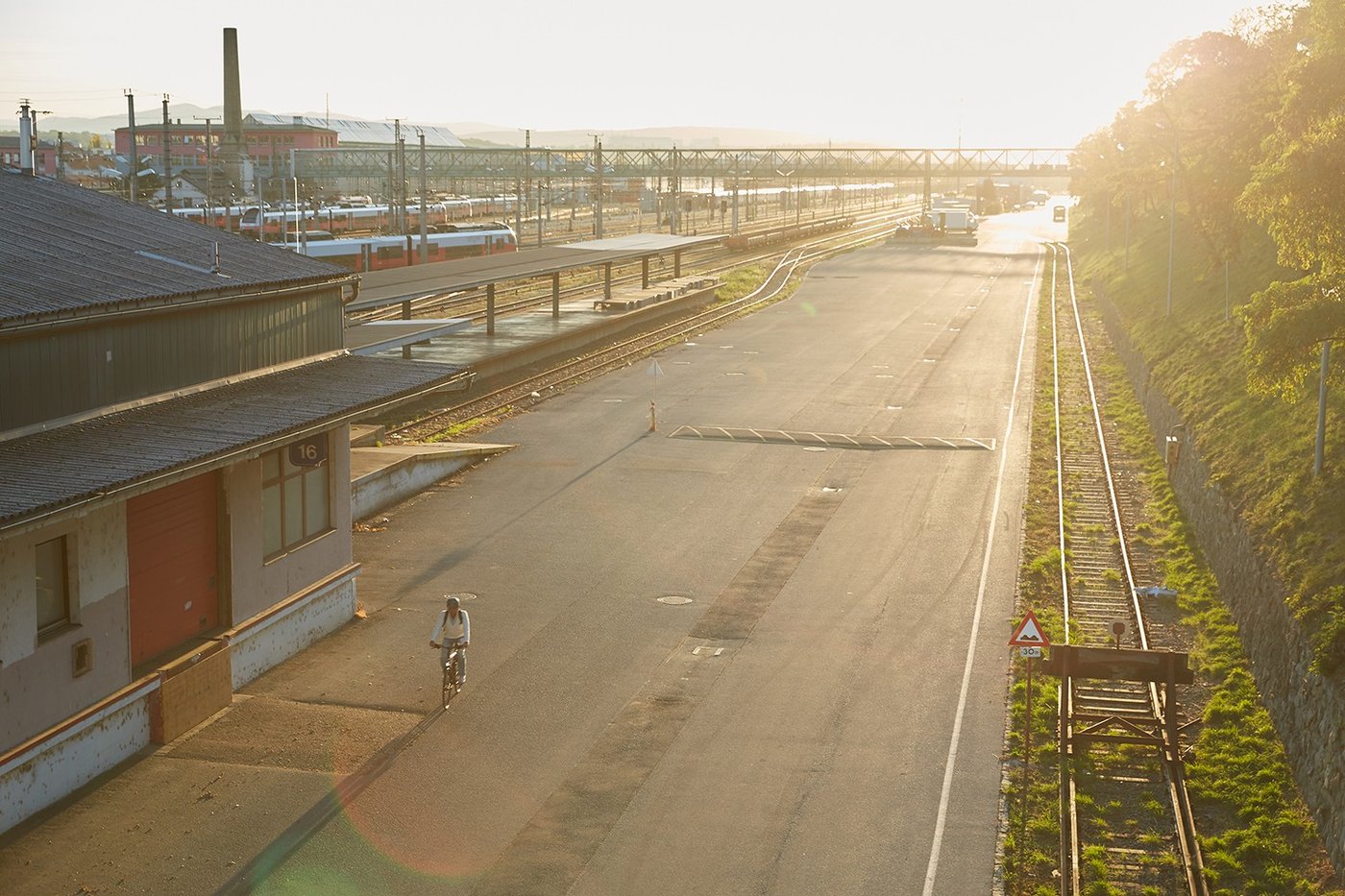
reale/non reale – methods of civil landscape engagement for Westbahnpark
A real-life experiment which strategically develops a utopian idea in order to challenge prevalent regular planning processes: Westbahnpark carries the vision of a linear park in the densely built up Gründerzeit area in Vienna. In the 15th district of the city of Vienna we find a number of superlatives: it is the most densely populated, and the poorest district, the youngest, and the least green and it houses the largest number of inhabitants of migrant background. Furthermore, it is cut in two by a railway track – the former Empress Elisabeth Railway – leading to today’s Westbahnhof. This railway triggers the vision of a park because it has produced an exceptional urban landscape with obvious spatial qualities offering a straight view out of the built-up city into the Vienna Woods, a protected landscape of woody hills in the west, as well as a view into the baroque park of Schönbrunn castle. In this dense district a view is an exciting experience along with a narrow and straight stroke of land of more than one kilometre length.
The planning system in Vienna constantly shifts between restriction and paternalism. It is proven to produce a liveable city but leaves extraordinary moves aside. The experiment Westbahnpark started out 2018 on this observation intending to trigger people’s own fantastic ideas of a possible utopia.
“BLA - office of droll concerns”, a performative group of a landscape architect, an artist, and an architect projected a future for this area which was intriguing, inventive, and fun. This sounds a first step of a usual landscape design, projecting a possible future onto a sight (or rather a piece of paper). In this case the invention was not on the side of the designers, who purposefully refrained from exposing designs, realistic renderings or other professional imagery. On a number of journeys, so-called visionary walks, into the future interested people were guided through the terrain and explained through earphones how it had been changed into the park, how planning policy has developed and which inventions were applied. The visitors’ imagination was stimulated by actors in swimming suits in front of the depot buildings, readers in the steep meadow, passers-by blowing bubbles. Westbahnpark is an ongoing process. Let’s explore, if and how this way of pushing the envelope is apt to get a vision on the ground.
Lilli Lička is a landscape architect, scholar, and activist. She was partner at koselička, Landscape Architecture with Ursula Kose from 1991-2016, directed the Institute for Landscape Architecture at BOKU University from 2003 to 2025, co-founded nextland, the collection of contemporary landscape architecture in Austria and LArchiv, Archive of Austrian Landscape Architecture, curated L-x, an international lecture series and is a founding member of performative activist groups BLA - Büro für lustige Angelegenheiten (office of droll concerns, 2012-2021), with Hannes Gröblacher and Karoline Seywald, which dealt performatively with social manifestations in public space; westbahnpark.live,an activist group using visionary methods to engage for a park in the built-up city of Vienna, and, most recently, WOOPS, Working on Outrageous Public Spaces, a performative artist collective with Hannes Gröblacher and Mira Samonig who are developing collaborative actions in public space in a one-year-residency in Bolzano with lungomare in the frame of the European project SITPLU, Situated practices in the pluriverse. Her work connects design, research, and public discourse.
The lecture takes place as part of the IKA Lecture Series Summer 2026 curated by Thilo Folkerts and Christina Condak.
Further lectures:
11.5.2026: An Fonteyne (NoAarchitecten), Brussels: KANAL - A Great Good Place
8.6.2026: Krater, Ljubljana: Krater Model: Toward Urban Ecological Regeneration through Culture
Locations Barrier-free access: https://www.akbild.ac.at/de/universitaet/standorte