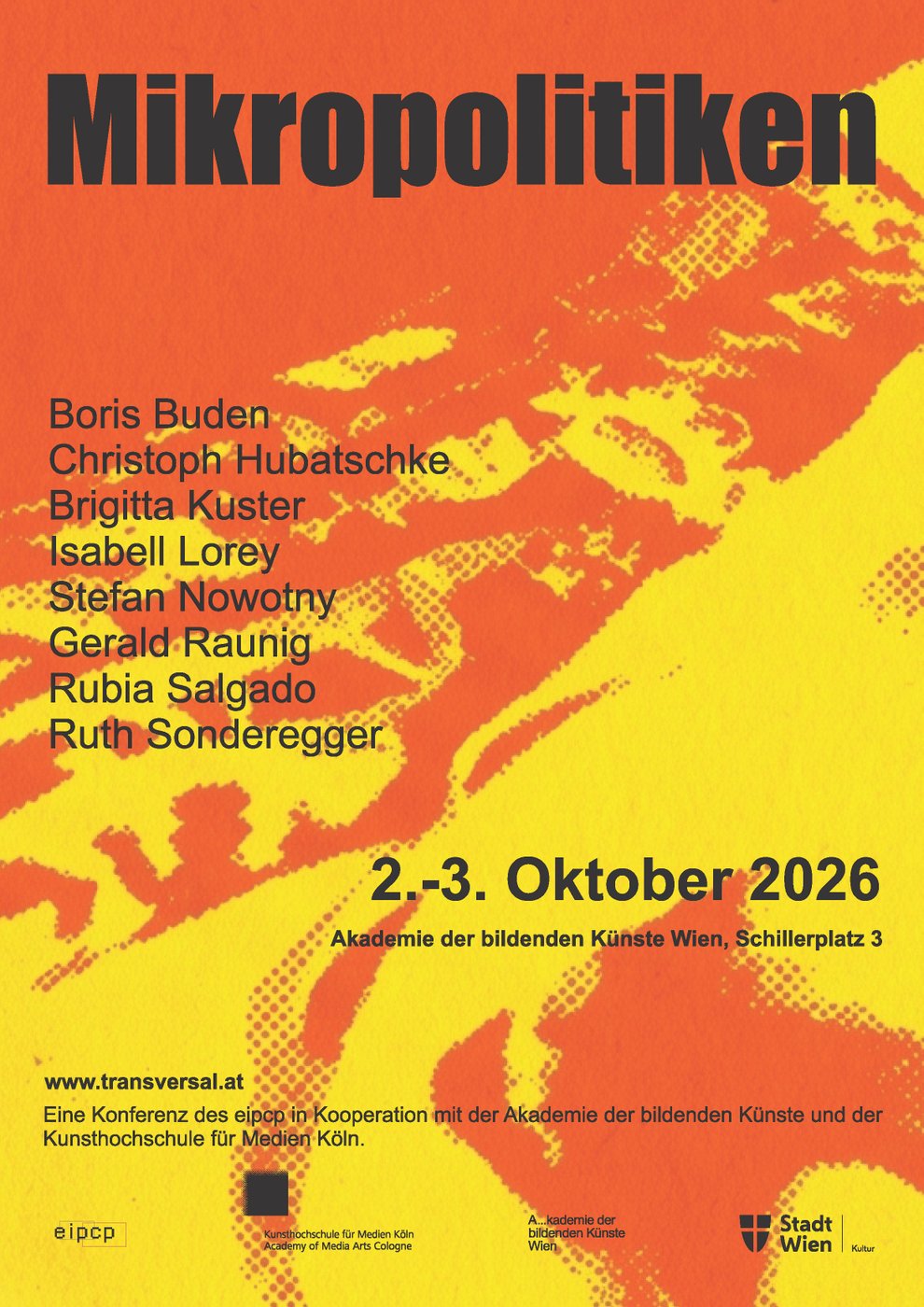
Micropolitics
A conference in collaboration between the Academy of Fine Arts Vienna, the Academy of Media Arts Cologne and the eipcp / European Institute for Progressive Cultural Policie.
“The micropolitical dimension will repeatedly return to all those insignificant elements, all those elements of singularity; it will complicate matters again at the very moment when one believed consensus had been reached. It is precisely at this moment that it becomes clear that there is no consensus; it is precisely at this moment that existence itself re-emerges in its singularity. This is the dimension – I would say: the line of flight – of micropolitics.” (Félix Guattari in a conversation with Suely Rolnik)
In the current manifestations of machinic capitalism, we find ourselves confronted with a complex web of identitarianisms, (micro-)fascisms and flows of affect, which does not simply ensnare, subjugate or eradicate individuals, but rather steers and optimises their flows. Here, government does not simply mean a structure that rules over us. Micropolitical self-government emerges in the pores, folds and fibres of social relations and technopolitical machines, in the daily practice of malice and hatred.
Yet it is not only new modes of government that arise in everyday life; it is also here that forms of resistance and singularities are produced which have the power to give rise to new forms of society. By subverting the dichotomy between the micro and the macro, micropolitics do not aim for institutional seizure of power; rather, they traverse the separation between the political and the social. Revolution appears here not simply as a project directed at states and institutions, but as a molecular revolution of modes of subjectivation, ways of life and processes of singularisation.
Building on several new volumes from transversal texts and following in the footsteps of Félix Guattari, Suely Rolnik, Michel Foucault and Gilles Deleuze, this international conference aims to highlight the relevance of micropolitical positions today and to examine the connection between this theoretical concept and current social movements.