Removal/Weggestaltung: Dealing with Problematic Memorials
The conference is organized by Eduard Freudmann, Jakob Krameritsch, and Ruth Sonderegger.
How should we deal with problematic monuments and memorials? When the political necessity arises to change manifestations of historical policy, art is often called upon to help. It is ascribed a high degree of problem-solving competence, while simultaneously having a severely limited scope for action. Hope is placed in concepts such as “artistic contextualization” and “artistic redesign.” This often involves distinguishing between demands for the removal of monuments, which are stylized as a cultural rupture with the accusation of monument-destroying historical erasure. In the heat of the moment, there is often neither time to differentiate between the two very different approaches of contextualization and redesign, nor to take removal seriously as a creative process.
In this sense, the concept of removal (in German: "Weggestaltung”) was introduced into the discourse in 2020 by the Austrian author Marlene Streeruwitz in connection with the discussions surrounding the Lueger memorial in Vienna. The term questions the status of the inviolability of problematic memorials and monuments and seeks to open up further creative avenues alongside existing concepts of contextualization and redesign.
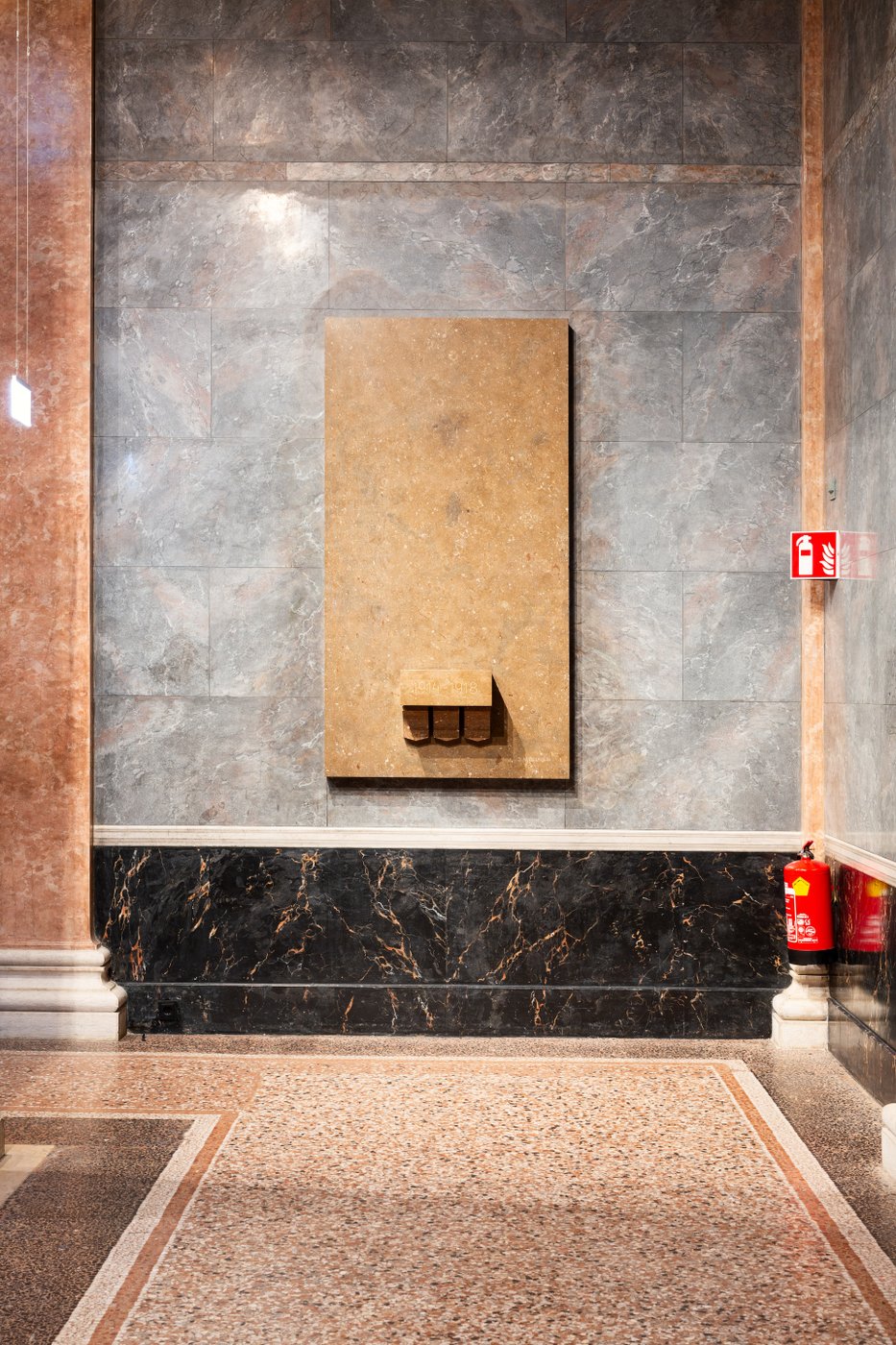
In November 2025, a bronze youth (1) standing in the Aula of the Academy of Fine Arts Vienna was removed. It was part of the "Heroes' Memorial for Fallen Art Academics." Its removal was preceded by years of discussions and artistic interventions. These discussions all shared the common thread of addressing possibilities for contemporary engagement with problematic manifestations of historical politics. Based on these debates, which revolved around authorship, social functions and reception history, as well as the aesthetics and meaning of the memorial, the conference will explore further examples and relate them to the concept of "Weggestaltung".
Progam
15 h Welcome: Ruth Sonderegger
15:15 h Marlene Streeruwitz: This Moment in Time
15:45 h Eduard Freudmann, Martina Genetti: Contextualization, Transformation, "Weggestaltung": An Attempt at Classification
16:15 h Urte Evert: Lenin’s Head and Hitler’s Horses: Collecting and Displaying Controversial Monuments in a Museum
17 h Tim Cole: Talking with the City about Colston
17:45 h Break
18 h Closing Panel with Deborah Benjamin Kaufmann, Paul Mahringer, Simon Nagy, and Tanja Schult. Moderated by Alina Strmljan
19:30 h Dinner
Abstracts
Marlene Streeruwitz: This Moment in Time
Even our moment, especially amidst all the wars and crises, will merge into time and become the past. But. Let us pause at this moment and consider, using the motif of the monument, in what form power entered the world and prevented a democratic culture before we were forced by wars and crises to deal with the politics of resource scarcity.
Eduard Freudmann and Martina Genetti: Contextualization, Redesign, "Weggestaltung": An Attempt at Classification
This presentation examines how to deal with problematic memorials and monuments, particularly common strategies such as contextualization, redesign, and "Weggestaltung. Using concrete examples, it attempts to classify these three approaches in order to reflect on their respective potentials and limitations.
Urte Evert: Lenin’s Head and Hitler’s Horses. Collecting and displaying controversial Monuments in a Museum
The museum „Unveiled: Berlin and its Monuments“ houses monuments that are no longer welcome in public spaces. These objects tell the story of the political upheavals in Germany, particularly during the 20th century. Since 2020, the focus has been on the permanent exhibition and its extension as a “simple” solution for problematic monuments – with regular new additions reflecting the ongoing debate surrounding the culture of remembrance.
Tim Cole: Talking with the city about Colston
After the toppling of the Colston statue in June 2020, the city of Bristol embarked on a lengthy process of consultation about what to do with the graffitied statue and empty plinth. This talk discusses this process and what was learnt from undertaking it both about how people think about contested heritage as well as ways of negotiating contested heritage in contemporary democracies.
Biographies
Tim Cole is Professor of Social History at the University of Bristol in the UK. His research ranges across social, cultural, spatial and environmental histories, specifically of the Holocaust and its aftermath, as well as working in the digital humanities and interdisciplinary and co-produced research. Tim was invited to chair the History Commission set up by the mayor of Bristol in the aftermath of the toppling of the Colston statue.
Urte Evert is Director of the Historical Museums at Spandau Citadel, Berlin. Her research focuses on everyday culture in military history and the history of objects, the history of fortifications, and the culture of remembrance. In particular, the handling of unwanted and toppled monuments, as well as ‘toxic’ art in public spaces, has become a central focus of her museum education work and her academic research.
Eduard Freudmann works as an artist focusing on critical remembrance culture in public spaces. He was a member of the artists' collective Schandwache and the collective Plattform Geschichtspolitik. He teaches and conducts research at the Academy of Fine Arts Vienna.
Martina Genetti is an art historian specializing in artistic interventions in monuments, particularly the critique and conflict surrounding the Lueger Monument in its history and present. She works in the contemporary art collection of the Wien Museum.
Deborah Benjamin Kaufmann is a poet, writer, and former president of the Austrian section of LICRA – Ligue Internationale Contre le Racisme et l’Antisémitisme (International League Against Racism and Antisemitism).
Paul Mahringer is an art historian who joined the Bundesdenkmalamt (Federal Monuments Office) in 2006 and has since headed the Department for Monument Research. His research focuses on the theory and history of Austrian monument preservation, particularly the architectural legacy of the Nazi era.
Simon Nagy works in the context of various collectives involved in art, text, and critical knowledge production in Vienna. He is a board member of the art education agency trafo.K, a member of the artists' collective Schandwache, and collaborates with Rosa Andraschek on antifascist art memorial projects in rural areas. His essay “Abolishing Time” was published in 2024 by Unrast Verlag.
Tanja Schult is an art historian researching democratic monument culture at the Institute for Futures Studies in Stockholm.
Ruth Sonderegger teaches philosophy and aesthetic theory at the Academy of Fine Arts Vienna.
Marlene Streeruwitz is an Austrian writer and playwright who critically examines feminist themes, power structures, and social conditions.
Alina Strmljan is a museologist, curator, and exhibition producer. Her work focuses on museum history and inclusion, exploring the interconnections between science, contemporary art, and the culture of remembrance.