Reenacting Revolution
Presentation of the arts-based research project Reenacting Revolution with Ana Adamović, Zsuzsi Flohr, Postdoctoral Researchers, Institute for Art Theory and Cultural Studies, and Dr. Tanja Petrović, Research Centre of the Slovenian Academy of Sciences and Arts, Ljubljana, moderated by Alena Williams, Professor for Theory and Mediation of Contemporary Art and Christian Kravagna, Professor for Postcolonial Studies.
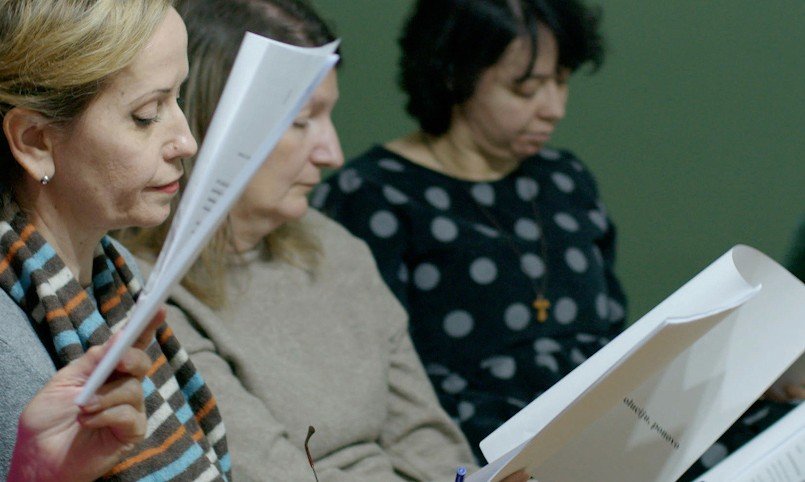
Can we imagine a new beginning, building of a world anew? Can we imagine a profound and overall change to our current circumstances today when inequalities and divides lying in the core of our societies are more evident by the day? Can we imagine it collectively? These questions are in the core of the Reenacting Revolution research project, funded by the Program for Arts-based Research (PEEK) of the Austrian Science Fund (FWF), which finds its point of departure in the now largely forgotten The Chimneys on the Adriatic, an opera written by Ivo Tijardović in 1949 and dedicated to the People’s Liberation Struggle during the Second World War.
Starting in 2024 in Serbia, while coinciding with the largest protest movement the country has witnessed, the research involved multitudes of different voices into the process of a collaborative development of a new art piece while investigating both art’s capacity and limits to actively participate in a broader social field of today.
Central to this process were collective readings of the opera’s libretto, organized across Serbia with more than eighty participants from different social and professional backgrounds. Reading aloud without assigned roles, participants were invited to interrupt, question, and comment on the text, connecting its historical language to their own experiences of labour, inequality, solidarity, and social change. These filmed encounters became an integral part of the new work, allowing participants’ voices, disagreements, and suggestions to influence its development.
Throughout this exploration, in which art becomes less a method of inclusion than a practice of redistribution – of voice, attention, authorship, and interpretive authority – the research is drawing on the ideas and practices coming from the Yugoslav socialist self-management project in which the field of art and culture was perceived as a politicized space for reinventing and enacting new, more humane social relations, while asking what can we learn from the future-oriented past? How can we employ it as a tool in the critical rethinking of our precarious present, utilize it as an asset in imagining possible futures? Finally, what does it mean to reenact revolution today?
Ana Adamović is a visual artist and researcher whose practice is primarily focusing on constructions of historical narratives and individual and collective memories. Her work was extensively exhibited in Serbia and abroad. Along with her individual practice, she is conducting various collaborative and arts-based research works within Belgrade-based Kiosk – Platform for Contemporary Art. She holds a PhD in Practice from the Institute of Fine Arts and the Institute for Art Theory and Cultural Studies, Academy of Fine Arts Vienna.
Zsuzsi Flohr is an artist and researcher working at the intersection of Holocaust and Memory Studies, material culture, and arts-based research. Her work explores the intergenerational transmission of memory, inherited trauma, and silence through family histories, objects, and archives. She received her PhD in Practice from the Academy of Fine Arts Vienna in 2024. In 2026, she received an Austrian Academy of Sciences (ÖAW) Post-DocTrack Fellowship to develop her doctoral dissertation into a monograph. Her research and artistic work have been presented internationally, including at the Jewish Museum Vienna, the Jewish Museum Munich, and the 59th Venice Biennale.
Tanja Petrović is principal research associate at the Institute of Culture and Memory Studies at the Research Centre of the Slovenian Academy of Sciences and Arts (ZRC SAZU) in Ljubljana. Her research interests focus on Yugoslav socialism and its afterlives, as well as in understandings of time, history and regimes of historization in the aftermath of Yugoslavia. She has published on anthropology of post-socialism, memory studies, masculinity, gender history, heritage studies, linguistic anthropology, and labor history. Her most recent book is Utopia of the Uniform: Affective Afterlives of the Yugoslav People's Army (Duke University Press, 2024). She is currently a research fellow at the ifk International Research Center for Cultural Studies in Vienna.