Making, Memory and Resistance – Textile Healing and Social Justice through the lens of decolonial Fashion Research, Art & Design
Opening of the exhibition series as part of the Erasmus+ project “Textile Healing and Social Justice”, developed by the University of Namibia, the University of Johannesburg, and the Academy of Fine Arts to create agency and reflective spaces through the lens of decolonial fashion research and design. Organized by Gestaltung im Kontext x MEZEKƎRƎ.
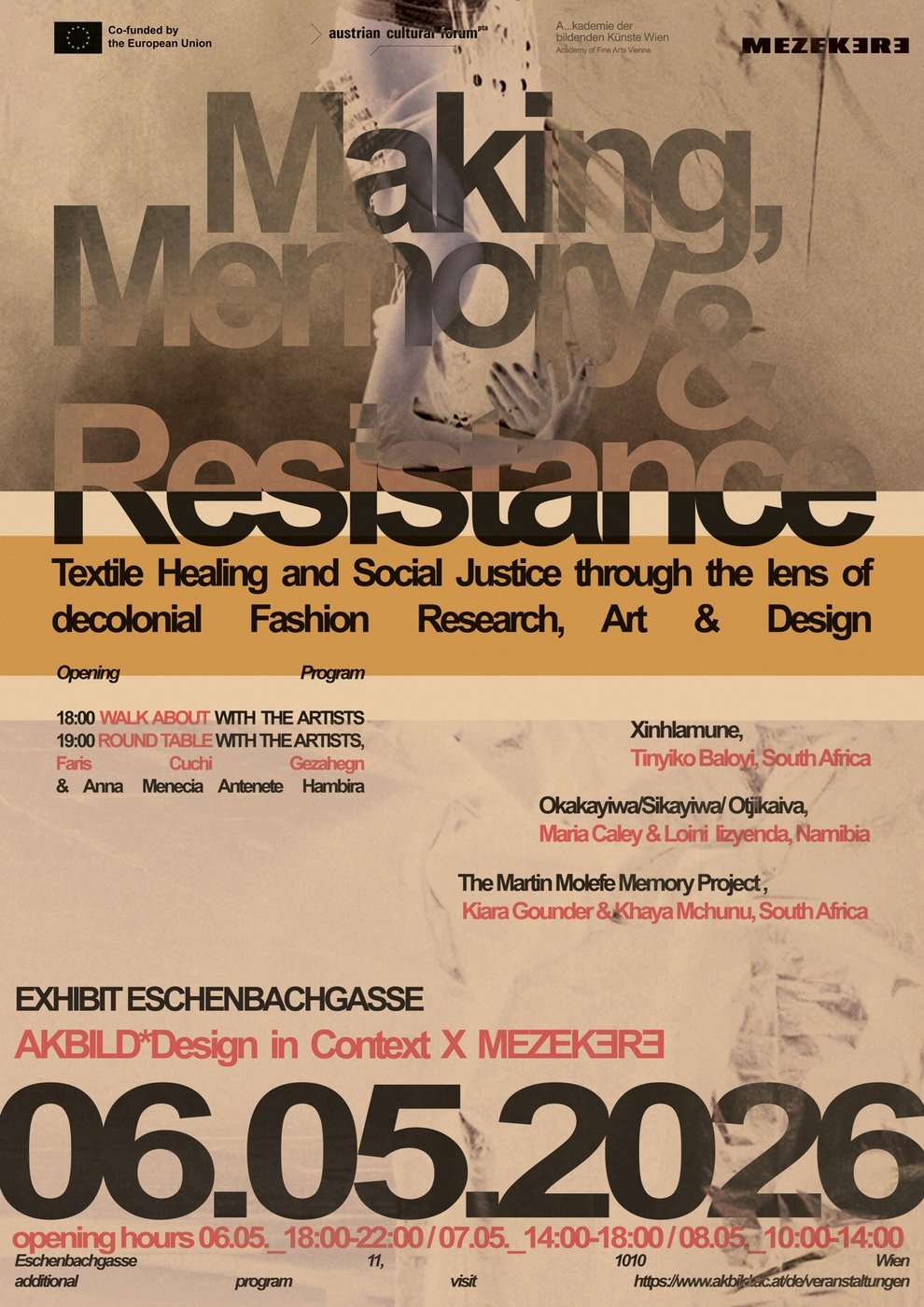
The pillars Memory and Resistance are reflected in research by Loini Iizyenda and Maria Caley (University of Namibia); The Martin Molefe Memory Project by Khaya Mchunu (University of Johannesburg) and Kiara Gounder (University of Durban); and Xinhlamune by Tinyiko Baloyi (University of Johannesburg).
The Martin Molefe Memory Project responds to Verne Harris’s claim in Ghosts of Archive that “South Africa is full of ghosts,” using archival ghosts to reactivate forgotten Black fashion histories. Martin Molefe, a Soweto-based designer active in the mid-1950s–1960s and published in Grace, Drum, Hi-Note, Zonk, and The Lincoln Star, is foregrounded through three provocations: his role in black pageantry and reported fashion shows (Provocation #1), dressing eighteen bridesmaids and two maids of honour for the 1962 royal wedding of King Moshoeshoe II and Queen Mamohato (Provocation #2), and his solo fashion show at Mofolo Hall—the reported first fashion show in Soweto (Provocation #3). These events function as provocations to situate fashion within the socio-political and cultural landscape of apartheid-era South Africa and to “communicate” with Molefe about black sartoriality and black fashion history. The installation presents garments as speculative re-imaginings, personifying archives as breathing—active objects whose vibrations tell little-known histories that deserve contemporary space.
Maria Caley’s and Loini Iizyenda’s research Okakayiwa/Sikayiwa/ Otjikaiva examines dress form—especially headwraps—to map how contract labour and missionization transformed dress among Aawambo, Kavango, and Ovaherero women in Namibia. Pre-colonial headdresses signified ethnicity, gender, and status; under colonial rule women were forced to remove hair and traditional headdresses and adopt Eurocentric dress and missionary standards, losing cultural identity and status markers. The forcible, humiliating removal of headdresses was especially traumatic; women were left with plain scarves or unshaven heads. As resistance in post-coloniality, new headwraps reemerged to express identity and status. The project uses creative, artistic research—archival sources, knowledge-keeper interviews, and a synthesized creative output—to explore okakayiwa, sikayiwa, and otjikaiva as symbols of femininity and self-fashioning, including the story of Sarah Womulaule to unpack missionization trauma and an interactive exhibition station to engage audiences.
Tinyiko Baloyi’s work Xinhlamune listens to the quiet intelligence held within Tsonga n’wana figures, approaching them not as artifacts but as pluraverses, self-contained worlds shaped by distinct ontologies of making. Each figure embodies a way of being in relation to matter, community, and environment. Form here is never neutral; proportion, balance, and restraint are expressions of lived philosophy. Our ways of being settle into the materials around us, and objects become crystallisations of relational knowledge. Guided by Pluriversal Design Theory, she engages these figures as teachers rather than references. Through textile and garment practice, she translates their embedded logics into contemporary form, working beyond dominant cut-and-sew systems. She folds instead of slice, knot instead of seam, and construct primarily from rectangles, foregrounding geometry, reversibility, and economy. These gestures echo the structural intelligence encoded within the figures. The resulting garments are not endpoints but objects of engagement, tactile sites for future learning. Within their folds reside specialised techniques that invite reconstruction, adaptation, and continuation. They demonstrate that technique is a mode of thought made material, and that innovation can emerge through dialogue with inherited worlds. In this way, the project affirms cultural artifacts as living repositories of design wisdom, capable of shaping both present practice and future possibility.
Timetable
18 h Welcome
with Angelina Kratschanova, International Office AKBILD & Anna Hambira, Fashions and Styles, AKBILD
Walk About
The Martin Molefe Memory Project with Kiara Gounder & Khaya Mchunu, South Africa (10min)
Xinhlamune with Tinyiko Baloyi, South Africa (10min)
Okakayiwa/Sikayiwa/ Otjikaiva with Maria Caley & Loini Iizyenda, Namibia (10min)
19 h Round Table
_a shared reflection on joyful resistance & activism, contemporary decolonial archive practices, indigenous (body-) knowledge & textile healing with AKBILD GUESTS and MEZEKƎRƎ guided by Anna Menecia Antenete Hambira
19:30 - 22 h Celebration