Invitation to the Defense of Patrick Layton
The Institute of Natural Sciences and Technology in the Arts at the Academy of Fine Arts Vienna kindly invites you to the defense of Patrick Layton's dissertation project "Ancient Book Crafts: Contactless dating of leather bindings".
The Examination Panel is made up of: Dipl. Ing. Dr.techn. Dubravka Jembrih Simbürger (chair), Univ. Prof. Dipl. Biol. Dr. Katja Sterflinger (supervisor), Ao.Univ.-Prof.i.R. Mag.rer.nat. Dr.rer.nat. Barbara Hinterstoisser (external appraiser).
The defense will take place in English at the INTK at Kelsenstraße 2, 1030 Vienna, EG, Raum 0.10, Seminarraum 2 and online via zoom.
Zoom-Link: https://akbild-ac-at.zoom.us/j/66052012511
Abstract
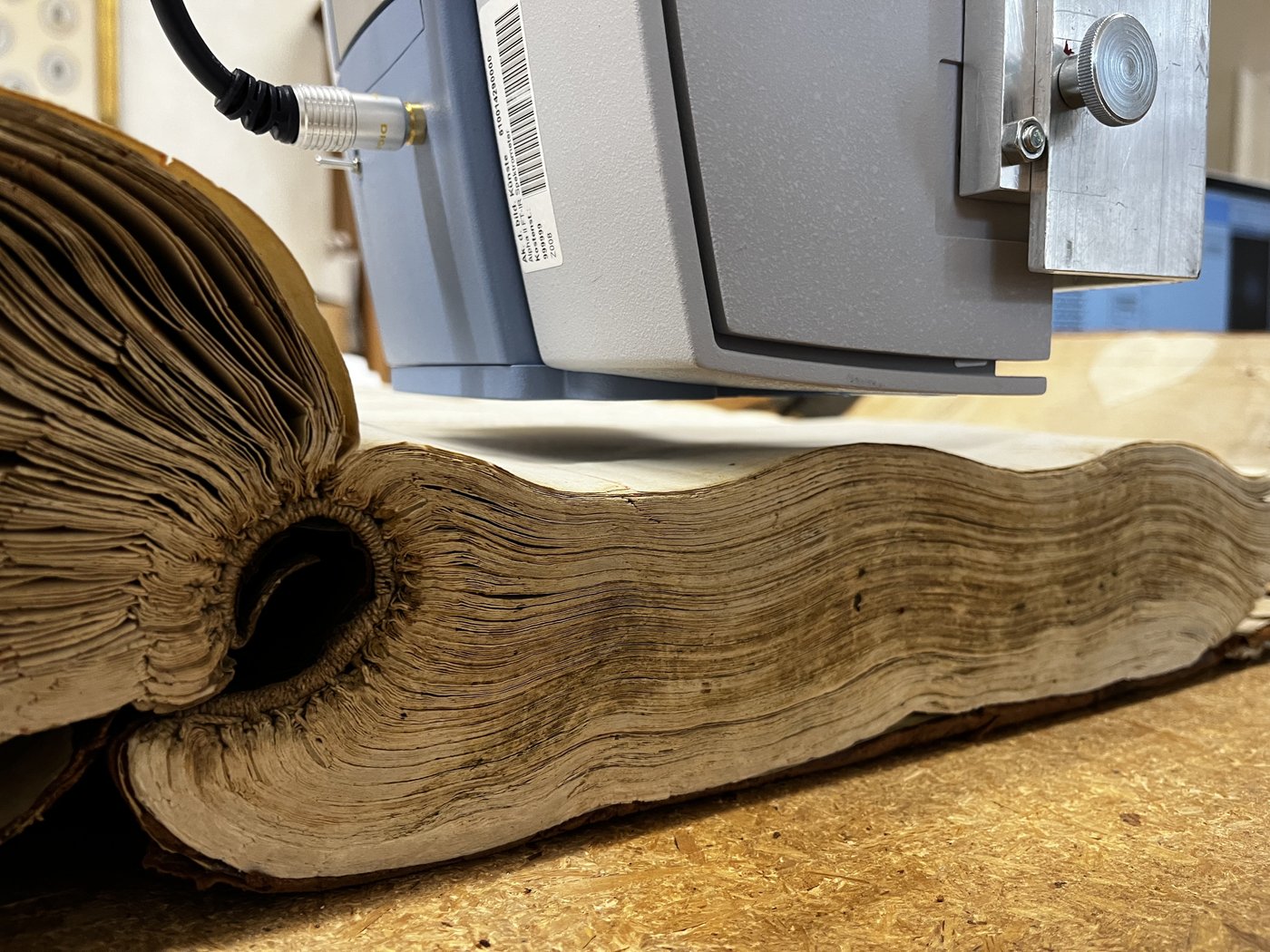
Historical manuscripts are vital cultural artifacts, yet determining their age and material origin often relies on destructive testing or time-intensive codicological analysis. Conventional spectroscopy faces severe constraints on bound manuscripts: Attenuated Total Reflectance (ATR) risks permanent physical compression, while Near-Infrared (NIR) light penetrates too deeply (1-5 mm), capturing underlying support boards. This dissertation establishes a non-contact, non-destructive analytical framework utilizing External Reflectance Fourier-Transform Infrared (ER-FTIR) spectroscopy (1-5 µm beam depth) coupled with chemometrics and machine learning to analyze manuscript substrates safely. Research focused on historical collections at Klosterneuburg Abbey, Austria. Principal Component Analysis (PCA) on 13 manuscripts established a standardized sampling protocol, identifying that non-age variances such as historical conservation, water damage, and spine stress, must be avoided. Applying Random Forest regression to 150 historical leather bindings (~1450-1824) achieved century-level dating accuracy with a Root Mean Squared Error of Prediction (RMSEP) of ±66 years on calibration data and ±68 years on an independent test set, driven primarily by C-H lipid breakdown (~2980-2960 cm⁻¹) and collagen backbone cleavage. Model testing on external library collections revealed that localized microclimates limit universal model transferability, necessitating institution-specific calibration. Finally, Partial Least Squares Discriminant Analysis (PLS-DA) on parchment substrate spectra successfully isolated species-specific collagen secondary structures (Amide I, II, and C-H₂ bending), yielding 70.1% accuracy (p < 0.001) in differentiating calf, ovine, and goat hides. This research demonstrates that contactless ER-FTIR combined with supervised learning provides a reliable, non-invasive diagnostic framework to complement traditional codicology and preserve irreplaceable heritage collections.
Short biography
For the past four years, I have served as a doctoral researcher at Akademie der bildenden Künste Wien, specializing in the development of non-destructive analytical methods for heritage science. My dissertation represents the culmination of this research, focusing on the contactless dating of historical leather bindings through External Reflectance FTIR coupled with machine learning statistics. This work bridges material analysis and book history, establishing a scalable, non- invasive protocol to assess collection materials from the late Middle Ages to the early 19th century for the collection of Klosterneuburg Abbey. Prior to my doctoral studies in Vienna, I spent thirteen years working as a professional book and paper conservator at Brigham Young University, Local Records for the state of Missouri, and at the University of Hawai`i at Manoa. During this time, I focused on preserving the general circulating collection, frequently teaching the material mechanics of historical book construction. Transitioning from hands-on conservation practice to scientific investigation allowed me to move from analyzing how historical volumes were assembled to understanding the chemical and material pathways of their aging. Moving forward, I aim to continue developing non-destructive diagnostic tools for cultural heritage collections, translating scientific methodologies into accessible workflows for conservators and institutional archives.