PLANT PLANT and Other Works, or to be made up of the Earth is not necessarily easy
Screening of Plant Plant, 2021 followed by an artist talk by Katrin Hornek as a part of the exhibition In the Fold of the Sack at Exhibit Gallery and Exhibit Studio.
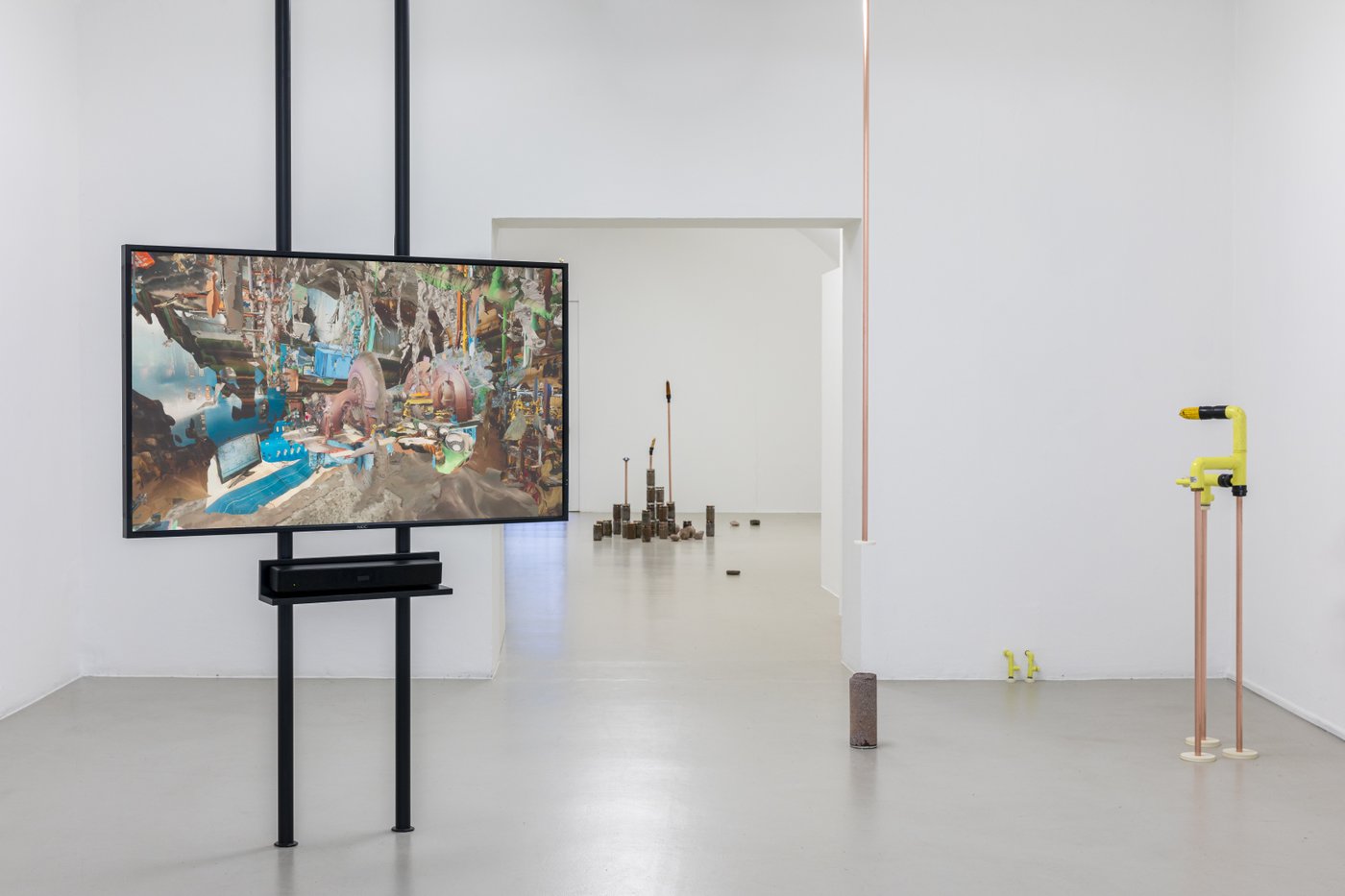
Katrin Hornek’s work playfully engages with the strange paradoxes and convergences of living in the age of the Anthropocene, that is, the proposed geologic epoch where the effects of capitalism, colonialism, and extractivism are written into the body of the earth. Both her artistic and her curatorial practice assert an understanding of the entwinement of nature and culture, implicitly arguing for more complex formulations, ones that reflect the ways in which our bodies, cultures, materials, and thoughts are all composed of the other creatures and rocks and air and water that make up our world. What Hornek highlights are the often uncomfortable juxtapositions between these things, and the ways in which we are both constituted and restrained by contemporary politics and materiality.
To be made up of the Earth is not necessarily easy, as her project Plant Plant demonstrates. It situates the chemical element of nitrogen as the prism through which to look at the history of fertilizer production with its immediate and planetary entanglements. "We make these fertilizers travel. From the atmosphere into the factories. From the factories into the fields. From the soil into the plants. From the plants into the human bodies. Into the bodies of livestock ... Building all proteins, all hormones, all DNA for the world "s populations" the voice-over in the film narrates. The choice of assuming both a molecular and earthly perspective to narrate this history makes graspable the otherwise invisible reciprocity and continuity across human, land, animal and techno bodies.
In her talk, she departs from Plant Plant, 2021 to explore her broader practice by tracing material flows, circulating discourses, and environmental transformations of which all living and dead bodies are part.
Katrin Hornek (1983*) lives and works in Vienna. She studied Performative Art and Sculpture at the Academy of Fine Arts Vienna and the Royal Danish Academy of Fine Arts. Her work playfully engages with the strange paradoxes and convergences of living in the age of the Anthropocene, that is, the geologic epoch where the effects of capitalism, colonialism, and extractivism are written into the body of the earth. Both her artistic and her curatorial practice assert an understanding of the entwinement of so-called nature and culture, implicitly arguing for more complex formulations – most recently, at Belvedere 21 (AT, 2025), secession (AT, 2024), ar/ge Kunst (IT, 2021), Kunstraum Lakeside (AT, 2021), the Riga Biennale (LV, 2020), and I: project space, Beijing (CN,2018). She teaches at the University of Applied Arts Vienna (Department of Site-Specific Art) and is a member of the interdisciplinary research group The Anthropocene Commons.
Outstanding Artist Award 2025, Msgr. Otto Mauer Award 2021, Studioprogram, Federal Ministry for Arts (2020-2026), Staatsstipendium für bildende Kunst 2017, Theodor Körner Award 2013, Artist Award, Lower Austria 2012.