Doing Nothing as a Solution? Taking Forests Out of Use as a Strategy for Nature and Climate Protection
A lecture by Georg Gratzer as part of the lecture series Lectures for Future.
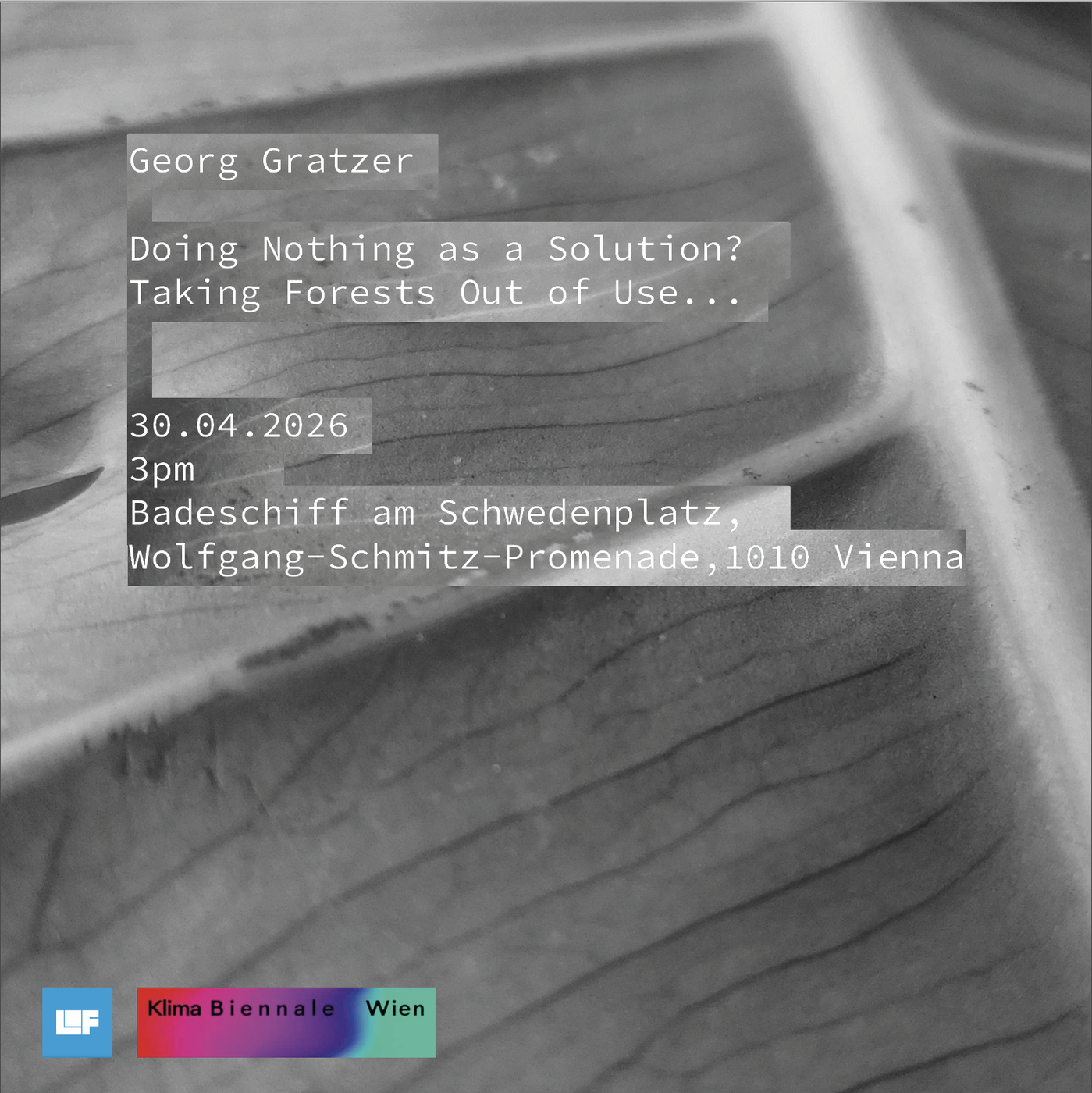
What happens when we stop intervening? This talk explores a concept increasingly discussed in forest policy and conservation strategy: the deliberate removal of forests and old-growth woodlands from active use as an effective tool for protecting biodiversity and the climate.
Drawing on current research from the Rothwald old-growth forest in the Wienerwald-Voralpen Biosphere Reserve — the largest contiguous primeval forest remnant in the entire Alpine arc — the talk demonstrates what ecological processes unfold when forests are left entirely to their own devices. The Rothwald in the Dürrenstein-Lassingtal wilderness area serves as a unique open-air laboratory: a forest untouched by human use for centuries, whose structures and dynamics offer invaluable insights into the natural resilience of forest ecosystems.
The talk poses a critical question: Is "doing nothing" really doing nothing — or is the decision to take a forest out of use one of the most powerful actions we can take? And what role can such wilderness areas play in our strategies against climate change and biodiversity loss?
Georg Gratzer is Professor of Forest Ecology at BOKU University Vienna, where he has been conducting research and teaching since 1997. He studied forestry at BOKU and completed his doctorate in 1997 on the regeneration ecology of silver fir forests, including research stays in Bhutan. In 2004, he completed his habilitation on the natural dynamics of temperate forests. His scientific interests focus on the dynamics of mountain forests, particularly how trees naturally regenerate in these demanding ecosystems.
In the ongoing FORSEE project, he investigates how seed production and germination capacity of forest trees change over time, with the goal of developing reliable predictive models for seed logistics.
Alongside his work in the Alps, he conducts regular research in the Eastern Himalayas and East Africa, working with local communities on sustainable resource use and poverty reduction. For him, ecological protection and improving the livelihoods of mountain communities are two sides of the same coin.
Since 2009, he has directed the international Master's programme in Mountain Forestry, bringing together students from mountain regions across the Himalayas, Africa, and the European Alps.
Through the Austria-wide UniNEtZ project, he co-coordinates university contributions to SDG 15 — Life on Land.