Werner Busch: Carstens and Koch. The Destruction of Central Perspective and the Role of the French Revolution
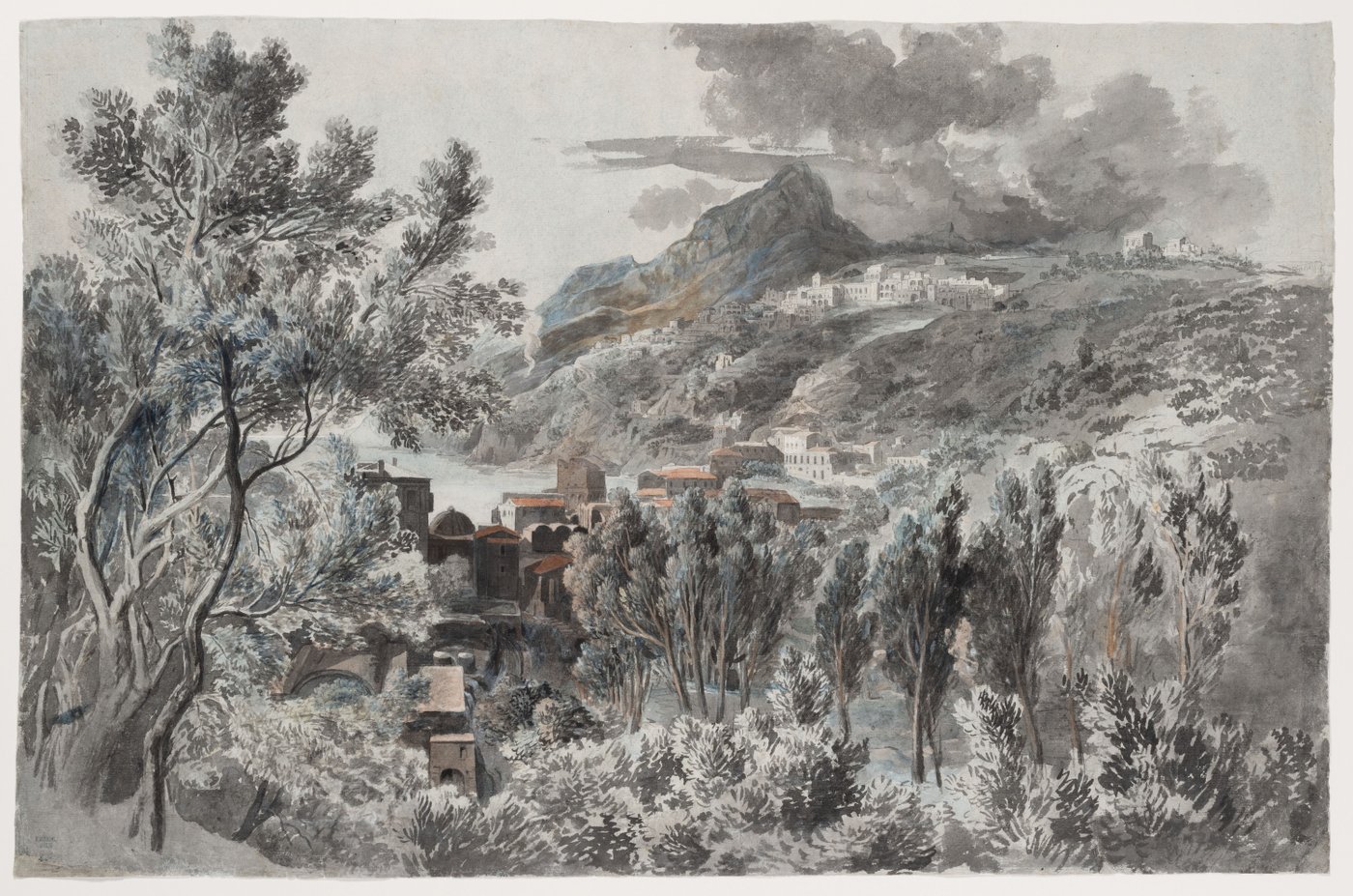
Asmus Jakob Carstens remains a Classicist in terms of his choice of subjects and his use of contour drawing, yet he pushes both beyond their traditional boundaries. This is due to his pursuit of freedom under the influence of the French Revolution, which seeks subjective expression. As a result, he no longer feels bound by the rules of perspective and anatomy. While Carstens relates the idea of freedom primarily to his artistic aspirations, Joseph Anton Koch is directly committed to the social and political ideas of the Revolution. In different ways, both artists undermine the classical concept of pictorial space.
Werner Busch studied art history in Tübingen, Freiburg, Vienna and London and received his doctorate in 1973 with a dissertation on William Hogarth. From 1974 to 1981, he was a research assistant in Bonn, where he completed his habilitation in 1980 with a study of nineteenth-century art. From 1981 to 1988, he held a professorship in Bochum; from 1983 to 1985, he directed the Funkkolleg Kunst. From 1988 to 2010, he held the Chair of Art History at Freie Universität Berlin. He is a member of the Berlin-Brandenburg Academy of Sciences and Humanities. From 2003 to 2009, he directed the Collaborative Research Centre “Aesthetic Experience in the Context of the Transgression of the Arts.” His research focuses on European art of the eighteenth and nineteenth centuries, the history of graphic art, art and science, and art theory. His most recent books include Die Künstleranekdote 1760–1960 (2020), Caspar David Friedrich (2021), Romantisches Kalkül (2023), and Leben im Exil (2025).
Lecture in German
Entrance free
Please register per email > kunstsammlungen@akbild.ac.at