Show printing in the intaglio printing workshop
In cooperation with the Graphic Collection, which introduces you to the world of intaglio prints by Martin Schongauer, Albrecht Dürer, and Rembrandt, we invite you to experience the complementary, practical, contemporary counterpart to this field of work following the guided tours. Students from various departments at the academy, who print small editions of their own work, will be giving visitors a glimpse behind the scenes.
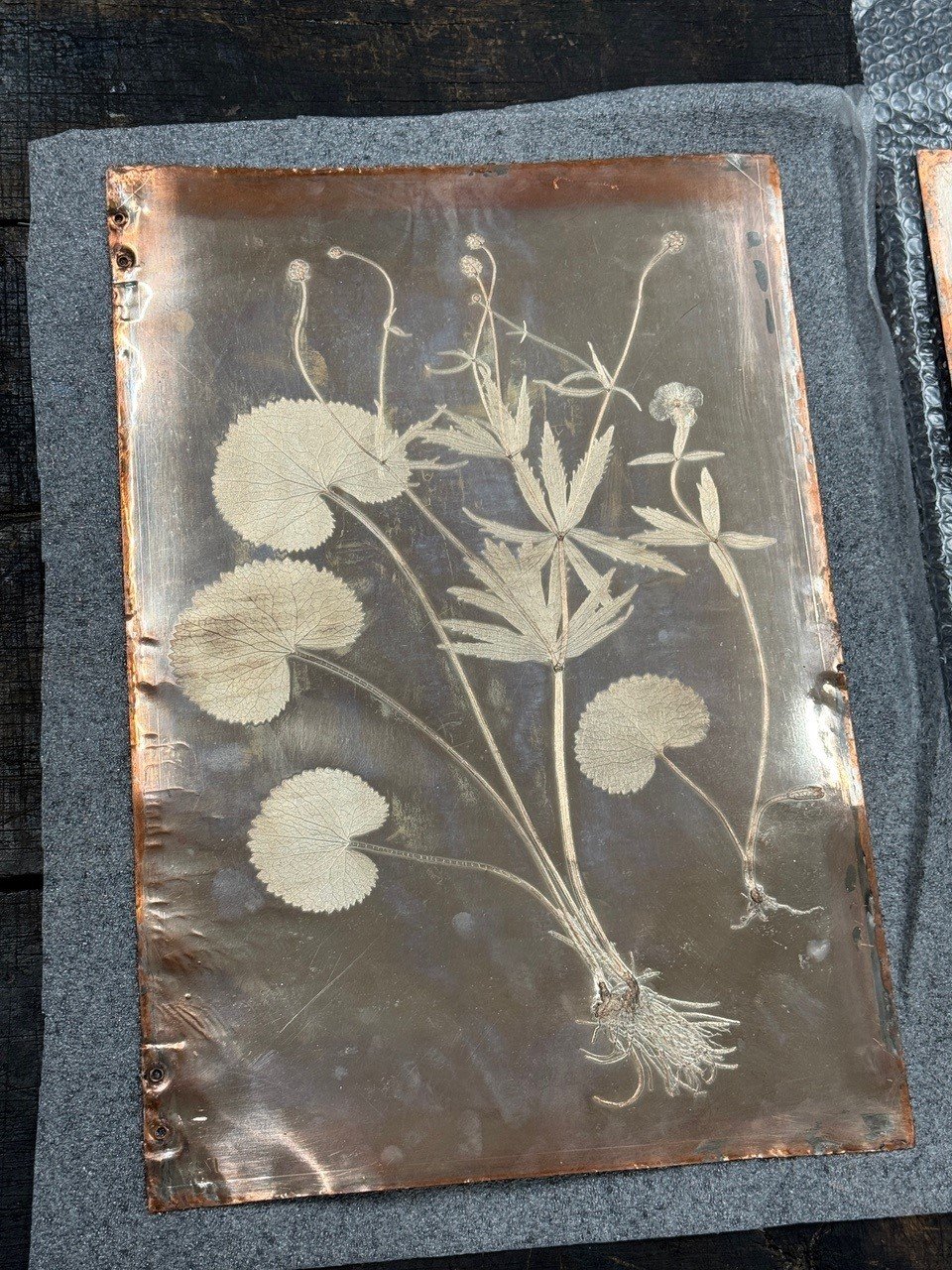
In addition, we are once again focusing on printing historical plates, as we have done in recent years. This year's resource once again consists of some very unusual plates. They come from a large collection of printing blocks Nature Self-Prints, the collection of Constantin von Ettinghausen and Alois Pokorny.
The research project, which is supported by the Austrian Academy of Sciences (ÖAW) and planned and carried out in collaboration with the Vienna University of Technology, the University of Vienna, and the University of Art and Design Linz, is currently dedicated to selected samples and is entitled: “PHELETYPIA, the impact of early photography and electrotyping media on the creation of images and contemporary art.” The natural self-prints made from these and similar plates have always been a source of great fascination and can be viewed up close at our show printing.
„PHELETYPIA examines original daguerreotypes from the early period of photography, produced according to specific Viennese methods, and asks what this research teaches us for the era of the digital image. The project uniquely combines photographic history, photochemistry, electrochemistry, conservation, and artistic research. We know very little about the properties of the early Viennese daguerreotypes, and even less about their transfer into electrodeposited printing plates for further photomechanical reproduction. Detailed research and comparison of the preserved daguerreotypes and photomechanical prints from Austrian and foreign collections will enable a detailed study of these pioneering methods from the early 1840s.“ {…}
„Another essential task of PHELETYPIA is to relate the findings on the early processes to reproduce photographic images to questions we are facing in the age of the digital. There, original and copy have become indistinguishable to a point that it no longer makes sense to apply these categories. These questions will be explored through artistic research: experiments will be undertaken to create a series of artworks. These will be shown in an exhibition conceived as a hybrid of a presentation of the scientific findings and an exhibition of contemporary artworks. This exhibition will accompany a concluding symposium at the end of the project.“
Find more about the Project: https://www.tuwien.at/en/research/facilities/xrc/projects/heritage-science-austria-pheletypia
The graphic - printmaking way of work identifies within the artistic practice of fine art, and is today more than ever an expression of its time, rather than a means to a goal. You can enjoy examples of this in the workshop exhibition.
This show presents the prints created as part of a collaborative printing project during the intaglio workshop by Janine Polak, an artist and teacher at SUNY Purchase College who traveled from New York as part of the ASA network partnership. Janine Polak's artistic practice could thus be traced and experienced in depth, while at the same time exchanging ideas about the differences and similarities in educational systems and political systems in the various places of action, which also became a more conscious shared space of experience. Find out more about Janine Polak's practice here: https://www.janinepolak.com/
We look forward to your interest!
No prior booking is necessary.