5 Questions for the Editors of Plant Space. Territories, Architectures, and Technologies of the Vegetal
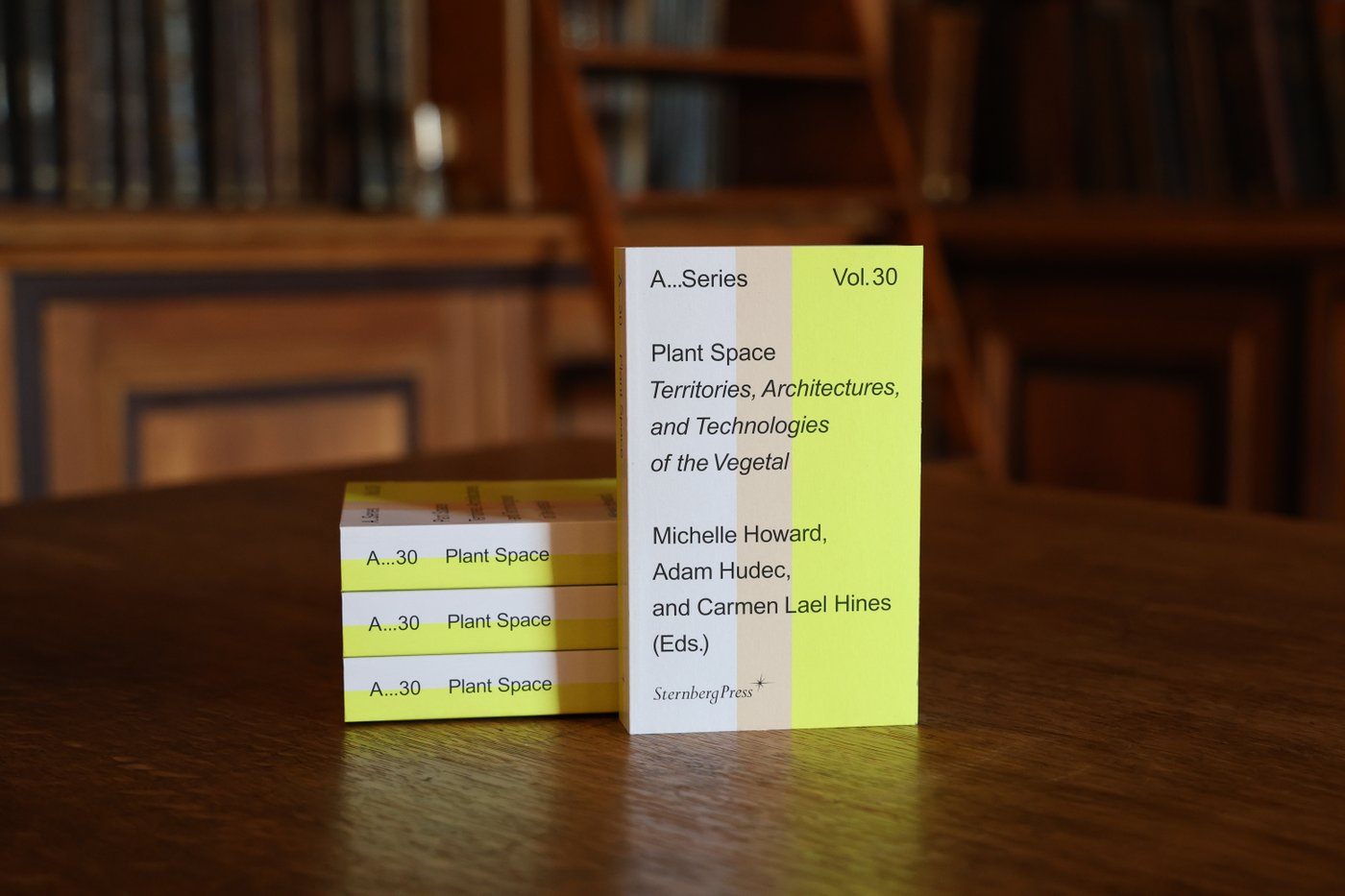
What changes when plants are no longer understood as passive elements, but as active agents in space, politics, and society? The recently published book Plant Space, Volume 30 of the Academy’s Publication Series, explores this question from various perspectives, bringing together architecture, ecology, technology, and colonial history. The editors—Michelle Howard, Adam Hudec, and Carmen Lael Hines—outline the publication’s key themes, such as plants as spatial and political forces and the question of what it might mean to consistently conceive of communication and knowledge beyond anthropocentrism.
What inspired you to create this publication? How did the idea come about?
The publication grew less out of a single idea or a formal call and more out of a web of encounters and shared projects. Through these encounters, we realized that we shared a similar critique of geopolitical chauvinisms. This led us to ask whether deprioritizing the Anthropos—the privileged position of the human—and centring vegetal life could become a tool for reinterpreting and resignifying the city and its spaces. The immediate catalyst was the exhibition Bordering Plants . The Wardian Case was at its centre. The book is not, however, a retrospective of the exhibition. Rather, we wanted to extend the questions it raised and bring together different voices whose thinking with plants is closely connected to their practical work.
What does the title Plant Space imply?
The title works on several levels. First, it questions the seemingly self-evident separation between outside and inside, between space and earth. Outer Space was coined by Alexander von Humboldt in Kosmos (1845)—a book informed by his travels through colonized territories. The term is therefore also situated within a Western history of representing nature as an aesthetic and ontological projection. At the same time, “plant” is both a noun and a verb. To plant means to take root, to spread, to adapt. It suggests emergence and a tension between persistence and limitation. Space, in this sense, is not a neutral container. It is shaped by seeds, roots, and branches, but also by boundaries and structures that determine what can grow, where, and under what constraints. And finally, the word “plant” linguistically connects to industrialism (power plant) and the violence of planting (holding down)—speaking to the judicial economic and patriarchal colonial histories that shape how nature has been extracted for global markets.
Plants are often referred to as active agents in your publication. What might this active role of plants look like in different contexts?
We understand plants as formative presences. They shape their surroundings, transform them, and continually negotiate with them. Plants are therefore not static or fixed entities. In the context of urban ecologies, for example, Michelle Howard’s Plant FERALcatalyst positions plants as infrastructural agents and considers rewilding as a form of spatial resistance. From a colonial-historical perspective, the Wardian Case shows how plants became embedded in logistical networks that enabled global colonial market systems. Plants also become agents within digital culture. In The Plant Complex, Carmen Lael Hines examines AI-generated plants, IKEA paradises, and plant influencers, asking how plants are produced, staged, and desired through digital culture. Another example concerns conflict and surveillance. In Looking at Trees, Catherina Selva examines how satellite imaging translates trees in colonized India and Palestine into data, placing them within new political and technological frameworks. Michelle Mlati and Pablo Barrios Martínez, meanwhile, trace palm trees across continents, moving between ideas of paradise and lost paradise. And You Should Really Talk to Plants asks what communication might look like if we stopped defining it exclusively through human language models. Across these different contexts, plants become key actants in political processes—in movement and circulation, in enclosure and control, and in spatial transformation.
Which aspects of plants highlighted in this volume should become part of general knowledge?
First of all, we should view plants as much more significant than technologies. The Wardian Case, for example, shows how plants could become a material basis for architectural surfaces, while also revealing how closely this was tied to an economic history of their instrumentalization. It is equally important to understand plants as spatial agents. They transform spaces through their seeds, roots, and branches. They are therefore not passive elements within a taxonomic order but actively participate in shaping their environments. There is also a political dimension. Plants are political subjects because they are entangled in geopolitical violence—from herbicidal warfare in Colombia to the draining of the Pontine Marshes. Plants can also be understood as economic indicators. The so-called “plant craze,” for example, reveals that the houseplant economy cannot be considered in isolation. It is connected to architecture, care, and complex socioeconomic networks. At the same time, plants are part of a colonial history. The Palm House in Vienna, for instance, stages nature as an aesthetic experience while also being embedded in forms of epistemic violence. Another important aspect is to think of plants as part of multispecies flows. Laÿna Droz proposes understanding ourselves and plants as “dynamic and porous nexuses of interconnected flows.” This shifts our understanding of what an individual or a species might actually be. And finally, plants can help us recognize the supposed separation between nature and culture as an ontological trap. Sylvia Wynter puts this problem very succinctly: “WE ARE THE ONLY SPECIES THAT GOES AROUND AND SAYS, ‘I’M A NATURAL ORGANISM!’” All of these perspectives challenge structures that seek to fix, classify, contain, or restrict plants. And those same structures are often implicated in the production and maintenance of injustice.
You Should Really Talk to Plants is the last chapter in the book. Why?
The concluding section, Conversations, brings together three interviews. This marks a shift from written argumentation to spoken dialogue, moving more strongly from analysis toward pedagogy. The conversation proposes a radical reimagining of communication that goes beyond human models of language. At the same time, it explores what a non-anthropocentric approach might mean for architectural education. The decision to place this conversation at the end of the book was therefore a deliberate choice. The book’s provocative ideas are not meant to be understood solely in theoretical terms but are also intended to have pedagogical and practical implications. Furthermore, the conversational format directly references the book’s genesis. Just as the book itself emerged from dialogues and encounters, it is also meant to spark new dialogues with its readers. The call to “truly speak with plants” thus brings us full circle. And the title itself is, of course, a provocation. Speaking with plants is not meant here as a mere metaphor, but as a methodological and ethical proposal. The aim is to rethink communication and knowledge—and, in the end, to leave readers not with a definitive conclusion, but with an open question.
book launch
Plant Space. Territories, Architectures and Technologies of the Vegetal
Michelle Howard, Adam Hudec, Carmen Lael Hines (Eds.)
Publication Series of the Academy of Fine Arts Vienna, vol. 30
London, Sternberg Press, 2026