Interview with Ulrike Müller
“Ideally, studying art is a transformative experience.”
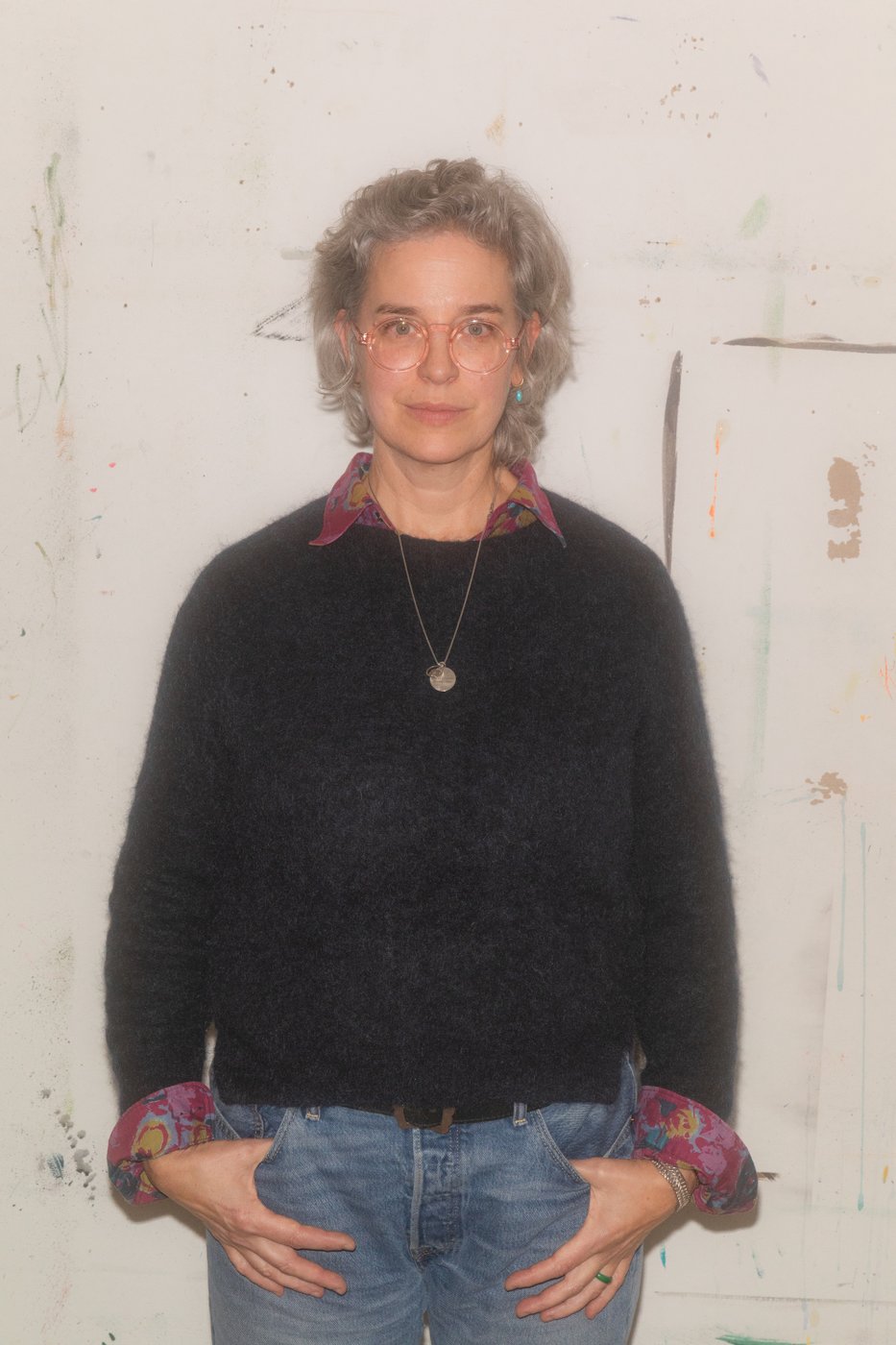
Since October, Ulrike Müller has been the professor of Art and Image | Figuration at the Academy of Fine Arts Vienna. The artist, who studied here herself in the 1990s, was already advocating for a stronger presence of women at the Academy back then. Her own artistic journey led her to an expanded concept of painting and to working with a variety of materials. She questions notions of authorship in art and repeatedly engages with museum collections and the archiving of queer-feminist history. From 2002, she lived in the U.S., where she continued to develop her own artistic practice and taught for many years. In this interview, she discusses how the institutional structures of the 1990s influenced her feminist politicization, why she is interested in culturally charged materials, and what she hopes to impart to her students.
You studied here at the Academy in the 1990s. Art universities—especially painting classes—were heavily male-dominated back then. There wasn’t a single tenured female professor at the Academy. How did you perceive this situation as a student?
I saw it as both a problem and a challenge, and I committed myself to raising awareness to this situation. At the time, it was very necessary to bring international perspectives and women as professors to the Academy, which is exactly what happened with Ute Meta Bauer, Renée Green and Sue Williams. By that time, however, I had already earned my diploma.
In which class did you study back then?
In a class that no longer exists. I completed the diploma program in tapestry in a studio building on Josefsgasse in the 8th district that has since been closed. The basic idea was to keep painting until a picture was good enough to be translated into a tapestry. I found that technically interesting, but it was also a very slow process. At the time I had pressing questions about the social role and function of art, and there was hardly any room for those there.
What artistic role models and points of reference did you have during that time?
Back then, we had to work hard to establish a framework for our own work. The professors tried to keep the class closed off. For example, we were actively discouraged from attending the then new Institute for Contemporary Art. That made it all the more interesting; it was an important place where a wide variety of artistic positions were presented. Due to the class’s focus on textiles, craft played a significant, but also gendered role. There were interesting courses that dealt with technique, materials, and specific processes. This complex mix led to my feminist politicization. I remember borrowing Rozsika Parker’s book The Subversive Stitch (1984) from the library and working with it. I was particularly impressed at the time by Renée Green’s Commemorative Toile (1992–1993). In this work, Green uses a historical fabric pattern to make the colonial legacy and the slave trade visible in the bourgeois living room.
How did your artistic practice develop in the 1990s?
After graduating from the Academy, I was active in the Freie Klasse Wien at the University of Applied Arts (1997–1999). A central concern of this self-organized class was to create feminist structures for art education that went beyond the curriculum. In the 1990s, art was shaped by discoursive approaches and had a critical orientation. This often meant a shift away from studio work toward project-based, research-driven artistic practice. At the time, this was also called “Post Studio.” For me, however, something was missing. Forms of experience and knowledge are lost when one abandons the studio and working with materials. I then tried to find my own path between these two positions: on the one hand, the concept of art in my class at the Academy, which seemed outdated, and on the other hand, a rejection of artistic work with materials in favor of purely conceptual approaches. So, I began to reconnect with painting and working with materials, informed by feminist and postcolonial criticism.
You have just taken over the professorship in Painting/Figuration—what do you mean by “figuration”?
By “figuration” I mean an active process that revolves around relationships and constellations. I think of the figure as a motif inherent to the image, but also of the figures of the painter and the viewer as specific bodies in space. Figuration has to do with seeing and being seen, with attributions as well as with misrecognition and projection.
One thing that has remained from your student days is that you still work with a wide variety of materials, from paper and enamel to wool. Do you yourself prefer to speak of “rugs” rather than “tapestries”?
I say “rug” partly to distance myself from the weight of the term “tapestry” and to emphasize the object’s use value. When working with different materials, I’m particularly interested in what these materials already bring to the table: wool, enamel, paper, wall paint. These are all materials with everyday relevance. I often work with found elements that I bring into the studio. During my studies these were initially patterned fabrics, this later evolved, for example, toward found colors. When I use colored pencils, the color palette is determined by decisions made prior to my artistic work. The same applies to enamel; there too I work with a predetermined palette and can only modulate colors relationally, that is, through their interaction. It wasn’t until I started working in the print shop that I began mixing colors. In my collaboration with Marina Ancona from 10 Grand Press (New York), she takes on the tasks of mixing and blending the inks, so I have to communicate which color I need. In this process, I must articulate my vision and, through collaboration with another person, translate it into a concrete result. On various levels, then, my work is about working with others and about taking culturally charged elements and establishing new relationships between them. I’m interested in the meanings inherent in things and what happens when you place them in different contexts.
The question of authorship therefore also plays a major role in your work. You have some pieces produced and explore who makes the decisions and who is considered the creator of a work of art. How did this interest develop?
Absolutely. I enjoy collaborating with others. Materiality and the question of authorship are closely intertwined in my work. When I reflect on found objects and elements with references to everyday life, I am simultaneously individualized as a signing artist, yet I also inscribe myself into chains of anonymized cultural production. This creates productive tensions regarding concepts such as authorship and the social positioning of art. In this context, questions of material, authorship, and feminism repeatedly overlap.
You also work with gendered materials and forms.
Yes, I work with gendered attributions. The fact that I was able to recognize their potential early on certainly has to do with the fact that I can look back on a history of feminist art and draw on the work of female artists in general and female painters in particular.
You also engage intensively with queer-feminist history and archival work. From 2009 to 2012, for example, you invited 100 artists to reinterpret historical feminist imagery from the Lesbian Herstory Archives in Brooklyn as part of Herstory Inventory. You were also co-editor of the queer-feminist journal LTTR. What role does this history play in your work?
These projects were consistently about creating self-determined spaces. Herstory Inventory. 100 Feminist Drawings by 100 Artists, to which you refer, is currently on view in the exhibition Feminist Futures Forever at Belvedere 21. For this project, I spent several years asking artists if they would be interested in reinterpreting historical feminist imagery. Image descriptions found in the Lesbian Herstory Archives in Brooklyn became drawing assignments. The historical images were not reproduced but rather translated by the participants into their own present context.
LTTR was a queer-feminist magazine that emerged in New York around 2001. I joined a few years later. The goal was to become visible as a group while simultaneously developing our own criteria and formats. We wanted to counteract the mechanisms of isolation that shape both art reception and the art market.
Does moving to the U.S.,specifically to New York, in 2002 seem to have been an essential catalyst for your artistic development?
Yes, definitely. In Vienna, after my time at the Academy, there were various artistic circles in which I was active. However, I didn’t manage to establish myself in the field of painting until I was in New York. I think that had a lot to do with the conditions there, and with a tradition of close observation and of talking about art that not only takes form seriously but places it at the center. Soon after my arrival, through my work with LTTR, I became part of a vibrant queer scene; at the same time, I spent a few days a week working in the studio of the painter David Reed. Through him, I was able to contribute to the exhibition project High Times, Hard Times. New York Painting 1967–1975. That was incredibly exciting and aligned with my interest in thinking about formal work and critical engagement together. In any case, it was very rewarding for me to be one of many painters in New York and to engage in active exchange with others. I was able to see a lot, discuss various ideas, and develop my own work in relation to other perspectives. During my years in New York, however, I also exhibited repeatedly in Austria and throughout Europe. I’d like to highlight two projects at mumok in Vienna, both in collaboration with Manuela Ammer. First, in 2015, a solo exhibition held in parallel with a new presentation of works from classical modernism titled Always, Always, Others, and then, in 2023, the major exhibition Das Tier in Dir (The Animal Within), in which we used the museum’s collection to explore the role of animals in modern and contemporary art. For this, I designed murals that spanned three floors of the museum, fragmentary shadows that could not be pieced together into a single image and indicated a presence outside the museum.
You’ve also created large-scale murals at the Queens Museum in New York and the Ludwigforum in Aachen, while other works, such as your collages or enamel paintings, are intentionally on a smaller scale…
Exactly. I started small, so to say, and over the years have developed a repertoire of formats: The enamel paintings are small in terms of painting, but quite large in terms of their material, which, as I use it, is otherwise primarily used today in jewelry production. The two facing murals in Aachen are each 14 meters high and 9 meters wide. Between them in the space, I’m displaying an architectural model of the museum, which is located in a former factory building, and my miniatures: miniature enamel paintings that can also be worn as pendants. I’m interested in different venues for art and how various formats engage with and address viewers: the enamel painting as a counterpart for an individual, who, under the right conditions, is reflected in its glossy surface. The large murals, on the other hand, raise questions about collective public spheres, including in relation to the history of muralism. In the exhibition Monument to my Paper Body in Aachen, I was concerned not least with an examination of “high art” in the sense of the values attributed to formats and media and how these are reflected in institutional architecture.
You’ve also taught in the U.S. over the past 15 years. What do you take away from this experience for your work in Vienna and for your current professorship?
I believe a great deal, pedagogically speaking. However, the institutional structures are quite different, so all of this is still in the process of taking shape. I taught painting for ten years in Bard College’s MFA program, which draws on the model of Black Mountain College. In this model, conversations among artists are central to art education, that is, an active exchange with colleagues and with students. Talking about art is at the heart of this, in studio visits and group critiques, also across disciplinary boundaries. I believe that we must always return to placing the image or art object itself at the center. From there, we attempt to approach it through language: What do we actually see? What elements are at play, and what meaning do we associate with them? It’s about exploring, through the process of close viewing, what a work of art evokes beyond the artist’s intention.
What attitude and understanding of art and artistic practice would you like to instill in your students?
My goal is to empower students to find their own artistic language. This includes critical engagement with the world and with the artistic legacy of their field, as well as immersion in creative activity and experimental processes that cannot be rationally understood in the moment. Ideally, studying art is a transformative experience; one grows, so to speak, beyond one’s own imagination. This is hard work and requires a great deal of courage—including the courage to fail.
Upon graduation, students should have a solid foundation for independent artistic practice—that is, they should have the methods and questions that will allow them to continue working on their own.
When you look back on your time as a student in the 1990s, do you see any parallels to the situation today?
As a student, I took part in demonstrations against the major university budget cuts in the mid-1990s. It was clear to me back then that free and barrier-free access to art education had to be defended and that this was about setting the course for broader societal changes. A few weeks ago, I was at the large protest against the newly approved university budget cuts, and I was pleased to see the large number of people on the street. But the fact that things have come to this again means that we must remain vigilant and politically engaged to ensure that independent and critical education at the international level continues to thrive at art universities.
(Interview: Helma Bittermann, 24.11.2026)