Interview with Claudia Larcher
“You can counter the grand narratives by looking just a little bit off to the side.”
Claudia Larcher has been a professor of post-digital art at the Academy of Fine Arts Vienna since early October. In her artistic practice, she combines photography, film, installation, and digital image production. She explores the materiality of the digital, artificial intelligence, archives, and the political conditions of technological systems. In this interview, she explains why “postdigital” does not mean the end of the digital for her, why errors and gaps in data systems are interesting, and why artists should not ignore AI.
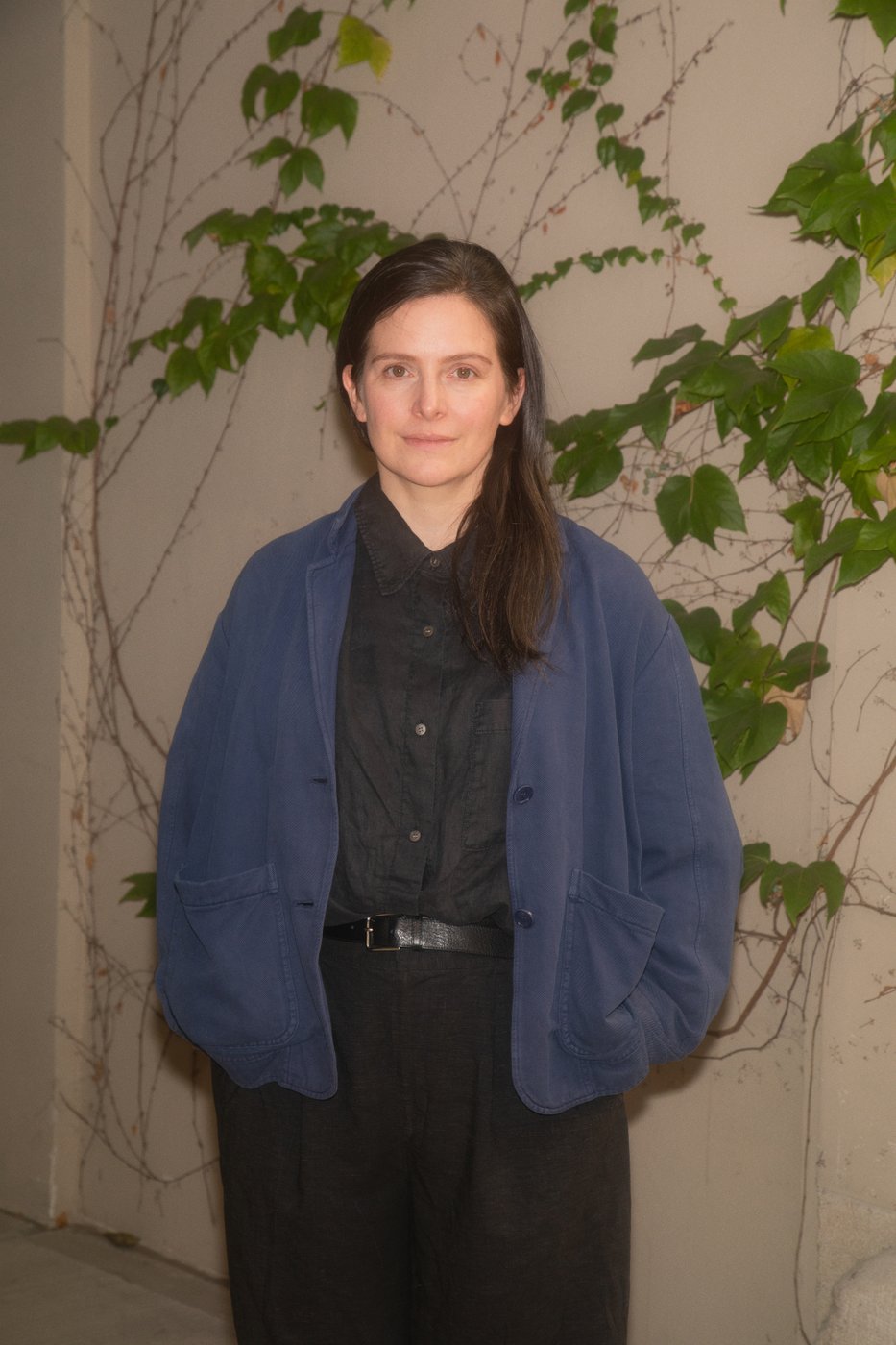
You’ve just joined the academy as a professor of post-digital art. What does that term mean?
Claudia Larcher: I believe that post-digital art is a form of art in which both analog and digital practices are possible and enrich one another. It’s not about working exclusively in digital media or focusing solely on algorithms, but rather about this interaction. The digital realm has become such a major part of our lives that it’s actually almost impossible to separate these categories anymore.
What do you hope students will bring to their engagement with new technologies? What kind of knowledge do they need, for example, to work with AI?
Larcher: I hope for an open-minded yet reflective approach. These things are already part of our everyday lives—in our phones, our computers; technology and AI are everywhere. That’s why I think the ethical aspect is important: How do these systems work? What data were they trained on? Who owns them? What ideologies are embedded in them? When I work artistically with a medium, I should know it well. Just as I know what I’m working with when I use brushes and paint, I should also know what I’m dealing with in the digital realm.
What is the purpose of art universities in this?
Larcher: I think it’s absolutely crucial that these questions be discussed at art universities. The art of tomorrow will be created by the people who are in university right now. Of course, one might ask: Is this art? Can AI art be art? How do we position ourselves on this? But I think it would be wrong to say, “Let’s set this aside for now and ignore it until it’s over.” That’s not going to happen. It’s going to become more dominant. We need to work on our own stance now. I don’t have a ready-made solution. I have approaches I’ve developed over the years through my work. And I hope for a productive discourse on this topic.
What else would you like to convey at the Academy?
Larcher: My medium is photography, film, and installation, but I also work in a very transdisciplinary way. I suddenly found myself delving into biology or oology—the study of bird eggs—through my grandfather’s collection. I find such niches very productive. I believe it’s important to immerse oneself in completely different fields from time to time. What can one bring to art from another field of knowledge? At the Academy, my work will be anchored in the research division and the PhD program. That’s exactly where the question arises: What is AI-assisted, and what is AI-generated? The guidelines are constantly changing. And of course I ask myself: What can young people save themselves the trouble of doing thanks to AI—and what should they not forget how to do?
You yourself studied under Bernhard Leitner and Peter Weibel. Did that time shape your relationship with technology?
Larcher: Yes. Back then, there was still this “tech-technical awareness”—this way of thinking about technology and open source. I picked up a certain wariness toward all these amazing products back then. That’s stayed with me to this day. Always taking a moment to ask: What’s behind it? What’s lurking there?
In your own work, there are very strong analog starting points. What role does the analog play for you?
Larcher: The fact that I work a lot with analog media is, of course, also due to my age. But I believe there’s something inherent in every human being: the use of one’s hands in art. This direct connection between hand and brain is different from the mediation provided by interfaces. The digital medium is still evolving. Perhaps at some point a more natural, universal fusion will take place. What we tend to forget is how unhealthy our interaction with these things can be—for our eyes, for our bodies. Because I also enjoy working in a transdisciplinary way, I’m interested in dance and performance as a medium. After all, we experience art not only with our eyes, but with our whole bodies. It’s also about sound and how we perceive a space—its acoustics, its temperature, and its architecture. We have countless interactions with our environment that we may not even be able to name yet.
You often work with collections and classification systems. In the experimental film Extinction Story, your grandfather’s private collection of bird eggs served as the starting point for your exploration of species extinction and human interference with nature. What fascinates you about such systems?
Larcher: You can gain an incredible amount of insight from data and classification systems. Even the question: What am I actually collecting, and why? For a long time, I wondered why my grandfather pursued this absurd hobby so excessively. Through the object of the egg, I was then able to try to understand something bigger and establish connections. Especially in the context of species extinction, this collection became very significant to me. When you compare this to AI systems, it gets even more interesting. There, too, huge amounts of data are used. Archives are data. Data is the new gold. But I’m just as interested in the gaps. After all, you can also learn something from the incompleteness of archives. These gaps fascinate me completely. Bias, errors—to me, that holds incredible artistic potential.
During his exhibition at the Academy in February, Alexander Kluge spoke of the need for a “counter-algorithm”. What could such a counter-algorithm achieve?
Larcher: I believe that by using systems in ways for which they were not designed, we can reveal the gaps and biases in those systems. These large companies often act as if what their systems produce is the absolute truth. But it isn’t. You can counter the grand narratives by looking just a little bit off to the side. You could train small systems on absurd data or on niche data. What the large language models do is also a kind of leveling—a reduction to a supposed normality: What is normative? I see that as a huge danger. I’m more interested in diversity. We have to be careful that diversity isn’t sacrificed to these standardized systems. And art, of course, offers a huge opportunity here. The Kluge exhibition was fantastic in this regard. Also, the way he played with these systems at his age. And I believe that this very act of playing with the systems is where the opportunity lies. The art academy is an ideal playground. I’d love to see many students take up this game and also ask themselves: How can I use these systems in ways that perhaps only an artist would think of? You don’t have to use these systems only as they’re intended. You can repurpose them, examine their flaws, and explore their limits.
Your works often address very fundamental political issues, yet at the same time they possess a distinctly subversive sense of humor.
Larcher: Yes. It’s okay to laugh, too. With one of my latest films, The End, someone once asked if it was even meant to be funny, because so many people found themselves laughing. The film is about the supposed end of cinema. If you listen to the AI gurus, some of them say that in the future, entire Hollywood productions could be created by AI. I thought to myself: Okay, then I’ll give it a try. I fed a concept into a system and intervened as little as possible. What was interesting was that errors and elements that weren’t particularly good kept getting processed further. As a result, everything became increasingly absurd. And then, of course, the question arises: Why should machines end up making a film if there’s no one left to watch it? If no one goes to the movies anymore—what’s left?
Can AI actually create art someday—and not just imitate it?
Larcher: I don’t think so at the moment. We want to see works by genuine artists. The systems still need content or an idea. Although they function quite autonomously in some respects, this autonomy has emerged within our capitalist system. Of course, it would be interesting to apply an AI system to creativity. But art is constantly changing. It responds to an interlocutor and processes that response. So far, I’ve seen systems that imitate very well. It looks like art, but it’s never really moved me. Maybe I’ll change my mind yet.
But AI is changing our relationship to art and our concept of artistry.
Larcher: Of course. There have always been artists who worked with craftspeople in studios. Even in contemporary art, much of the work isn’t necessarily executed by the artist themselves, but rather in workshops following their instructions. This raises the question: Do we look at a sculpture because we see the vision of a great artist behind it, or because it was produced by the artist themselves? And what about industrially produced objects? Today we can 3D print and 3D scan. You could train a model to produce something that looks as if it were spontaneously handmade. Then the question is: How do I contextualize that? In what setting do I display it? I do believe that these “live” moments are becoming important again. You can see that in the fact that performance art is experiencing a real resurgence. The theaters are full. People are going to the theater and the movies. Perhaps there’s a need for a collective space of reception.
You studied at university when many of today’s AI systems didn’t even exist yet. At the same time, the idea of technology taking on a life of its own was already around back then. What has changed?
Larcher: Actually, this narrative keeps coming up. Even in the past, people said AI would wipe us out. Now that headline is back. I think we should look at where the capital is. One huge area, of course, is military technology. These dimensions sometimes get lost in the public discussion. I find it incredibly irresponsible that private companies are developing these systems—based on the overexploitation of data, rare earth elements, and infrastructure, that is, ecosystems. And this is happening in the midst of a climate crisis. This doomsday scenario weighed heavily on me for a long time. Perhaps that was also one reason why I wanted to delve deeper into these systems. I wanted to understand how they work so that I could even form an opinion about them. Today, I’m more inclined to believe that humans will wipe out humans than that an AI system will wipe out humans.