Opening
On the exhibition
Sabine Folie, Director Art Collections
Helmut Draxler, Curator
Opening
Ingeborg Erhart, Vice-Rector for Art and Teaching
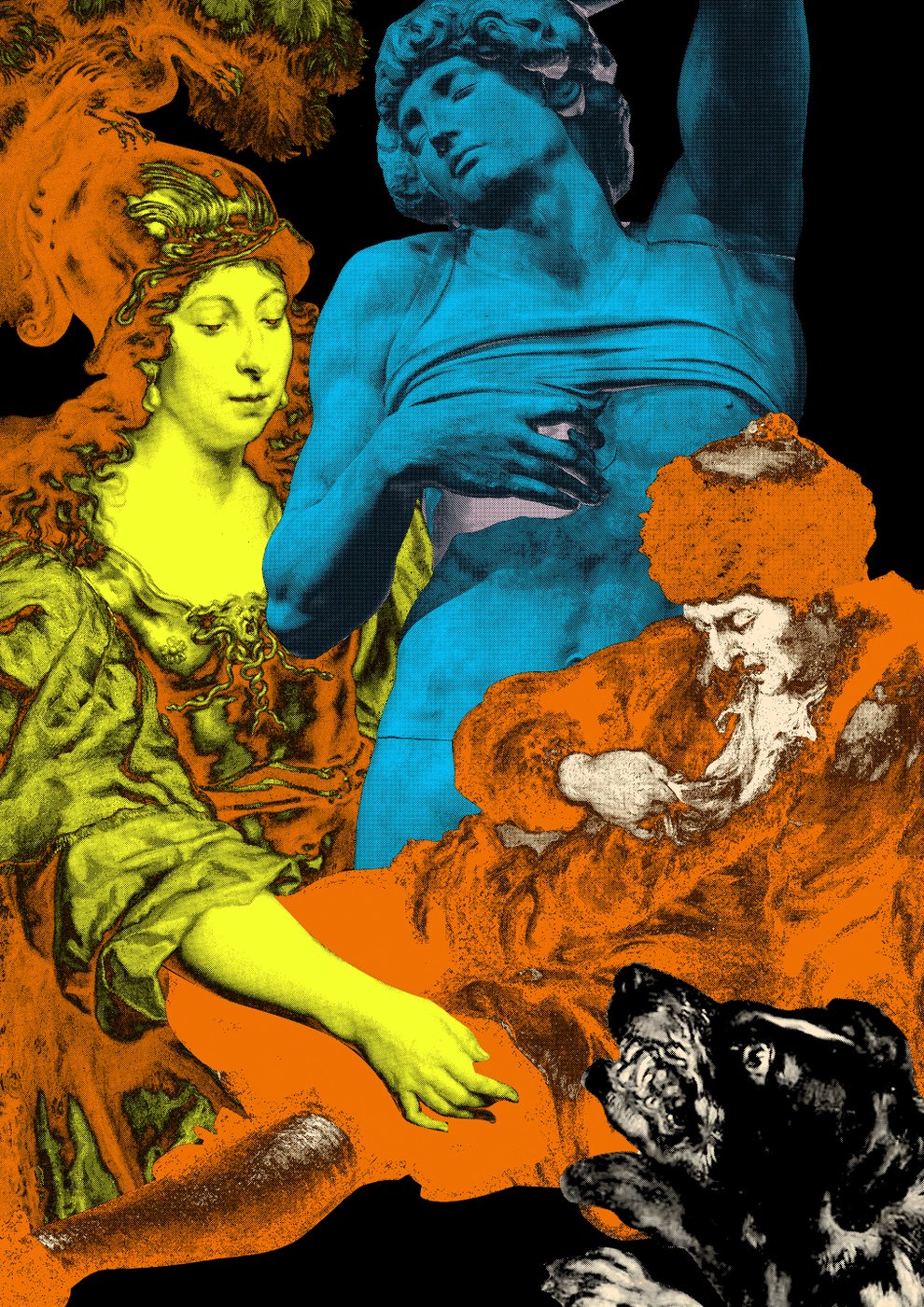
The exhibition The Great Michelangelo Is Dead! Avant-Garde & Academicism is held on occasion of a tercentenary: in 1726, what is now the Academy of Fine Arts Vienna was given its statutes, modelled on those of the French academy. But rather than recounting a linear history of the institution, the presentation invites viewers on a lively stroll through the history of academies more generally. It is animated by a productive debate: what counts as academic, what as avantgarde – and who decides?
Academicism and avant-garde do not figure in it as simple opposites. As the exhibition demonstrates, the two concepts continually challenge, interrogate, and transform each other. What takes the stage as radical today can become part of a canon tomorrow; what is considered obsolete may suddenly seem relevant to present-day concerns when it appears in a new context. Artistic renewal, it emerges, often springs up where rules, models, and institutions are called into question.
The tour begins in the sixteenth century, with the founding of the Accademia del Disegno in Florence and Giorgio Vasari, who exalted Michelangelo as the ideal embodiment of the “divine” artist. It moves on to the academies in France and Germany, spotlighting a series of reforms, crises, and counter-movements including the Nazarenes in Vienna, the masterclass model, the Bauhaus and Vkhutemas, the altercations at the academies of the 1960s and 1970s, and, most recently, the debates around Bologna, the educational turn, diversity, identity politics, and global shifts in the art world.
One particular strength of the exhibition is the venue itself: the Vienna Academy boasts three eminent collections of paintings, graphic art, and plaster casts. The presentation subjects these historical holdings to fresh scrutiny and stages them in dialogue with significant loans as well as contemporary positions.
Works by Vasari, Le Brun, Poussin, Sandrart, and others encounter pieces by artists including Picabia, Lichtenstein, and Immendorff. New works create specially for the exhibition frame a broader perspective on the present and its engagement with art history. In so doing, they also bring into focus the copy, a genre long dismissed as inferior to the avant-garde’s original work, as an artistic practice in its own right. Appropriation, reiteration, and re-enactment demonstrate that academic techniques can become tools of the avant-garde in turn. In this way, the display weaves a multifaceted essay across time – vivid, unexpected, and open-ended.
The exhibition not only asks what academies were, it also inquires into what they can be today: scenes of learning, dissent, collectionbuilding, criticism, and visions for the future.
The Great Michelangelo Is Dead! brings home the fact that art history is not a fixed legacy but an ongoing dialogue between tradition and new beginnings.
With historical works from the Art Collections of the Academy of Fine Arts Vienna – Paintings Gallery, Graphic Collection, and Plaster Cast Collection – supplemented by numerous loans
Sandro Botticelli, Sébastien Bourdon (attributed), Heinrich Friedrich Füger, Artemisia Gentileschi (attributed), William Hogarth, Johann Baptist Lampi the Elder, Charles Le Brun, Franz Anton Maulbertsch, Francis Picabia, Nicolas Poussin, Rembrandt, Peter Paul Rubens, Joachim von Sandrart, Julius Schnorr von Carolsfeld, Jakob van Schuppen, George Stubbs, Pierre Subleyras, Titian, Giorgio Vasari, Ferdinand Georg Waldmüller, Januarius Zick et al.
Plaster casts after Michelangelo Buonarroti, Antonio Canova et al., as well as Écorché (anatomical figure) by Johann Martin Fischer
Contemporary artists: Abel Auer, Alice Creischer, Vaginal Davis, Stephan Dillemuth, Thomas Eggerer, Michaela Eichwald, Abdulnasser Gharem, Wolfgang Hollegha, Andy Hope 1930, Jörg Immendorff, Stephan Janitzky, Martin Kippenberger, Jutta Koether, Louise Lawler, Roy Lichtenstein, Markus Lüpertz, Birgit Megerle, Ariane Mueller, Chris Reinecke, Gunter Reski, Katharina Sieverding, Hong Zeiss und and Heimo Zobernig
Presentation of works from the Flemish, Dutch and Old German schools from the collection of the Paintings Gallery as a ‘gallery painting’
Curated by Helmut Draxler
With curatorial contributions by Claudia Koch (chapter Gallery Painting) and Hans-Jürgen Hafner (chapter Düsseldorf Academy)