Invitation to the Defense of claudia* sandoval romero
The Institute for Art Theory and Cultural Studies at the Academy of Fine Arts Vienna kindly invites you to the defense of claudia* sandoval romero's dissertation project "Searching for Palenques between the Periphery and Center: A Relational Case Between the Photographic Work of Nora Aslan (AR) and Rochelle Costi (BR) and the Museological Framework".
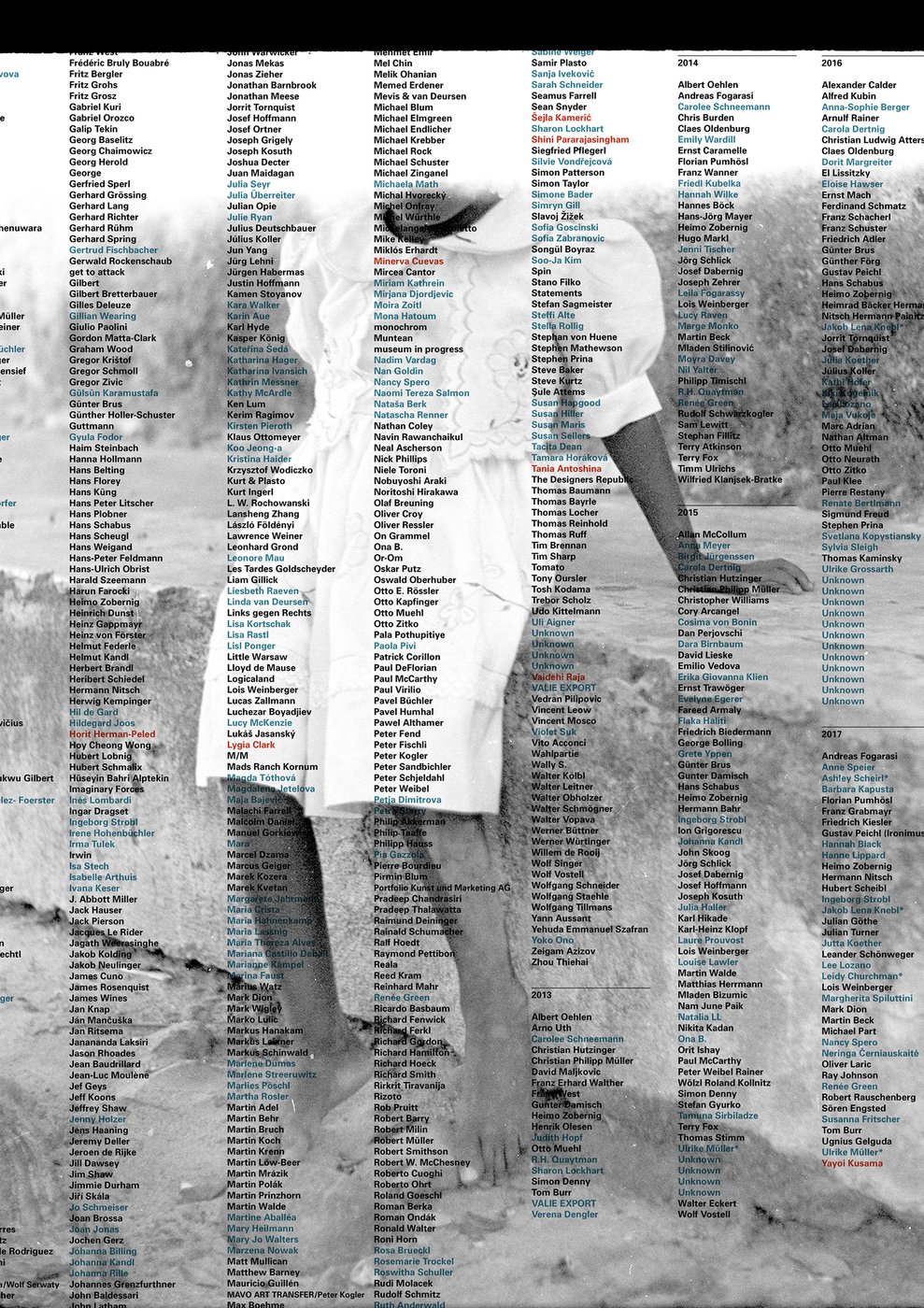
The Examination Panel is made up of: Doz. Mag Dr. Assoc. Prof. Axel Stockburger (chair), PD Dr. phil. habil. Jens Kastner (supervisor 1), Nelson Maldonado-Torres (external appraiser, University of Connecticut).
The defense will take place in English at room M20 at the Academy.
Abstract
In the two decades between 1998 and 2018, a decade on either side of the 2008 global economic collapse (Brown 2015, Temin 2010), Museum moderner Kunst Stiftung Ludwig Wien –mumok acquired the work of two female artists from Latin America. These artists use photography as their expressive medium (mumok 2018 and 2019).
The dissertation examines the representation of female visual artists of the Global South at mumok through the acquisition of photographic works of Argentinian artist Nora Aslan (born in Buenos Aires, 1937) and Brazilian artist Rochelle Costi (born in Caxias do Sul, Brazil, 1961 – passing in São Paulo, on 26 November 2022).
The research engages with the thesis that photography by female artists has found more entry into the mumok collection than work by female artists in other mediums of visual art. This thesis is critically analyzed through the three works acquired by mumok between 1998 and 2018, which are connected by the geopolitical translocations the works themselves encountered, or those faced by the artists that produced them before the pieces reached their final destination in mumok.
These acquisitions included Bedrooms São Paulo 10 and 12 (180 x 230 cm each.) by Rochelle Costi, 1995, consisting of two photographs which joined mumok’s collection in 1999, and the mixed media, photo paper on canvas Alfombra (Tapestry in English. 200 x 160 cm) by Argentinian Nora Aslan, 199, which joined the collection in 2000.
The dissertation investigates the ways in which these two female photographers are framed within the entire acquisitions of mumok over the specified timeframe (mumok 2018, 2019) and inquire the positioning of female and non-binary (*) artists, their countries of origin and their expressive medium within the collection and exhibition program of mumok over the same period (Sandoval Romero 2020).
French sociologist Pierre Bourdieu’s field theory provides the theoretical basis for this analysis (cf. Bourdieu 1989, 1995, 1995a, 2000 and 2010, Jurt 1995 and 1998, Kastner 2009), specifically to investigate the role played by peripheral instances such as the Global South and the female in relation to the center of the art field (cf. Acha 1993 and 2004, Buchholz 2016 and 2018, Buchholz, Wuggenig 2005, Buenaventura 2012, Canclini 1999, Kastner 2007, Lagnado 2000, Munder, Wuggening 2012, Steyerl 2011, Traba 1974 and 2005, Wagner 2007).
The research is located in fields of visual culture and the sociology of art, which are based on a critique of power and dominance, and complemented by a feminist approach (cf. Butler 1999; Crenshaw 1998; Cumes 2018, 2019, 2021; Gago 2020, Haraway 2016; Lugones 2007; Mendoza 2019; Segato 2003).
The research follows a trans-disciplinary approach. Its starting point is the material as well as the connections emerging from the relations of the material within its context. Methods from the cultural sciences, media sciences, and qualitative and quantitative social investigation are thus brought together. Based on a critical reading of the associations between the artworks and the literature, a systematic deScolonial analysis of photography in the contemporary time is carried out within the framing of modern and contemporary art museums and their archives.
Additionally, for this research I undertake the task of creating an archive of the works that participated in the exhibition programs as well as I contrast it to mumok’s acquisitions statistics from between 1998 and 2018 (mumok 2018 and 2019) and the exhibition program over the same period (Sandoval Romero 2020), (cf. Bourdieu 2006 and 2010, Buchholz 2016 and 2018, Buchholz, Wuggenig 2005, Hassler 2017, Konrad 2008 and 2011).
My doctoral thesis aims to contribute to the cultural-scientific discourse on the representation of female and non-binary (*) visual artists of the Global South from a subjective-critical perspective, through addressing questions on representation, positioning in the artistic field, and power relationships within the museological context. In doing so, the thesis also aims to contribute to debates about loss, mourning and restitution of the denied position for women and non-binary people in the symbolic field.
Short biography
claudia* sandoval romero is an Austro-Colombian journalist, researcher and transdisciplinary artist. At the heart of sandoval romero’s proposal is a critical reflection on archives and counter- archives, care work and the pursuit of epistemological justice within the contact zones.
sandoval romero’s work engages deeply with feminisms (*), horizontal pedagogies and practices of deScoloniality, driven by a commitment to expose power relations and open up spaces for erased voices to be heard. This approach to art is nurtured by the driving force of creating pedagogical spaces of horizontal exchange, contributing to the urgent debates around loss, mourning and restitution for women and non-binary people (*) of the Global South—voices systematically erased from the symbolic, economic and social fields.
sandoval romero’s practice spans photography, film/video and research, fusing sociological methods with collective creation.
claudia* sandoval romero holds a Bachelor in Media and Journalism (University of Valle, Colombia), a Master in New Media Art (University of Sao Paulo, Brazil) and a Master in Critical Studies (Academy of Fine Arts Vienna). sandoval romero's doctoral research at the Academy of Fine Arts is supported by the DOC Scholarship of the Austrian Academy of Sciences (ÖAW) and the Dissertation Completion Fellowship of the Academy of Fine Arts.