Doomscrolling with Rob Swainston
In collaboration with the International Office (Angelina Kratschanova), the class Art and Image | Graphics (Christian Schwarzwald), the class Art and Space | Object (with Michael Part), and the IBK Intaglio Workshop (with Renata Darabant), we are pleased to invite our colleague Rob Swainston from SUNY Purchase, NY—partner institution in our ASA Network—to discuss his artistic practice. We look forward to seeing many of you there!
Rob Swainston is an artist, educator, and printmaker born in rural Pennsylvania who currently lives and works in New York City. He is an Associate Professor of Printmaking at Purchase College and co-founder and Master Printer for collaborative fine art printshop Prints of Darkness. In 2020-21 Rob was a Guest Professor in Printmaking at the Weißensee Kunsthochschule Berlin. Rob’s work sits at the intersection of printmaking, painting, sculpture, and installation and is informed by a dual academic background in Political Science and Fine Art. Rob has been awarded numerous residencies including Skowhegan, Marie Walsh Sharpe, and the Fine Arts Work Center. Solo and group exhibitions include Marginal Utility, David Krut Projects, Bravin Lee Programs, Socrates Sculpture Park, Smack Mellon, Provincetown Art Association and Museum, Print Center of New York, Canada Gallery, Queens Museum, and the Bronx Museum. Rob’s project, Doomscrolling, a collaboration with Zorawar Sidhu, first showed at Petzel Gallery, NYC, in 2022. Doomscrolling explored in large-scale color woodcut the tumultuous events of 2020/21—Covid, Black Lives Matter, and the American election cycle. Watch the video introduction to the project. Collectively, Sidhu and Swainston explore the intersection of historical print processes with contemporary technologies. Their projects investigate the complexities of contemporary social issues, drawing from the history of print as the medium par excellence of social movements. Linking old and new media is a way to slow down our read of contemporary news and social media. Works from Doomscrolling have been included in group exhibitions at Princeton Museum, Museum of Contemporary Art Arlington, and Gemäldegalerie Berlin. The Hall Foundation, VT, showed the entire cycle in their 2024 season. The project has entered numerous significant public and private collections including Museum of Modern Art (MoMA), National Gallery D.C., Museum of Fine Art (MFA) Houston, Staateliche Museen zu Berlin, the Hall Foundation, and the Jordan Schnitzer Family Foundation. Sidhu and Swainston’s 2025 show at Petzel, Flash Point, ran March 7-April 12. Rob is represented by Petzel Gallery in New York City.
Collaborative Projects
Rob often works collaboratively. Sidhu and Swainston are a collaborative printmaking duo exploring the intersection of historical print processes and contemporary media as a way to think through contemporary social, political, and ecological conditions with the shared conviction that art can catalyze social change. Printmaking is inherently collaborative and Sidhu and Swainston feel strongly that artists working collectively model a cooperative democratic discourse essential for our politically and environmentally challenged times. While their work spans all the major print disciplines, their primary focus is woodcut. Woodcut is a medium of the people: a medium that gives expression to anti-authoritarian movements and facilitates the mass distribution of ideas.
In their Doomscrolling series, made during the 2020-21 pandemic, many of Manhattan’s retail storefronts and institutions boarded up their windows with plywood. Much of this plywood became the surface for graffiti expressing solidarity with the protest movements. As institutions began to take these physical barriers down, they rescued this conceptually charged material for multi-color woodcut prints. This is further examined in their Doomscrolling video.
In Essential Services (2020), a large-scale public-facing installation at 601 Artspace in New York City, Sidhu and Swainston boarded up a gallery using this same reclaimed plywood. This installation functioned as a site of collaboration between art institutional spaces and public voices. In dialogue with the marks left by protestors, they carved and printed an image of a recent public demonstration, referencing the woodblock print’s historic link to dissent. By returning this material to the public as a monumental artwork, they sought to transform a remnant of crisis into an expression of solidarity, care, and collective memory.
War for the Union (2024-25) looks toward distinctly American political issues. Layered with appropriated images from historical news media, such as Harper’s Weekly’s wood engravings of the American Civil War, this series suggests both the cyclical temporality of images in American journalism and a collective fear of a second Civil War in the current American political climate.
Plywood is a material both politically charged and emblematic of the Anthropocene. It is a natural material subjected to unnatural processes: a tree that has been peeled, glued, and pressed into a flat sheet. For Flash Point, made using a custom-built press to accommodate the scale of these works, Swainston and Sidhu made woodcuts from plywood as a metaphor for the human impact on the planet. Referencing canonical artworks, this series links historical visual allegories to current social conditions and humanitarian issues; for example, their Raft (2024) depicts contemporary displaced peoples within a history of forced migrations. Our House Is on Fire (2025) combines a 19th-century landscape with the forest fires that are an increasingly present feature of our existence. This project is described in their Flash Point video.
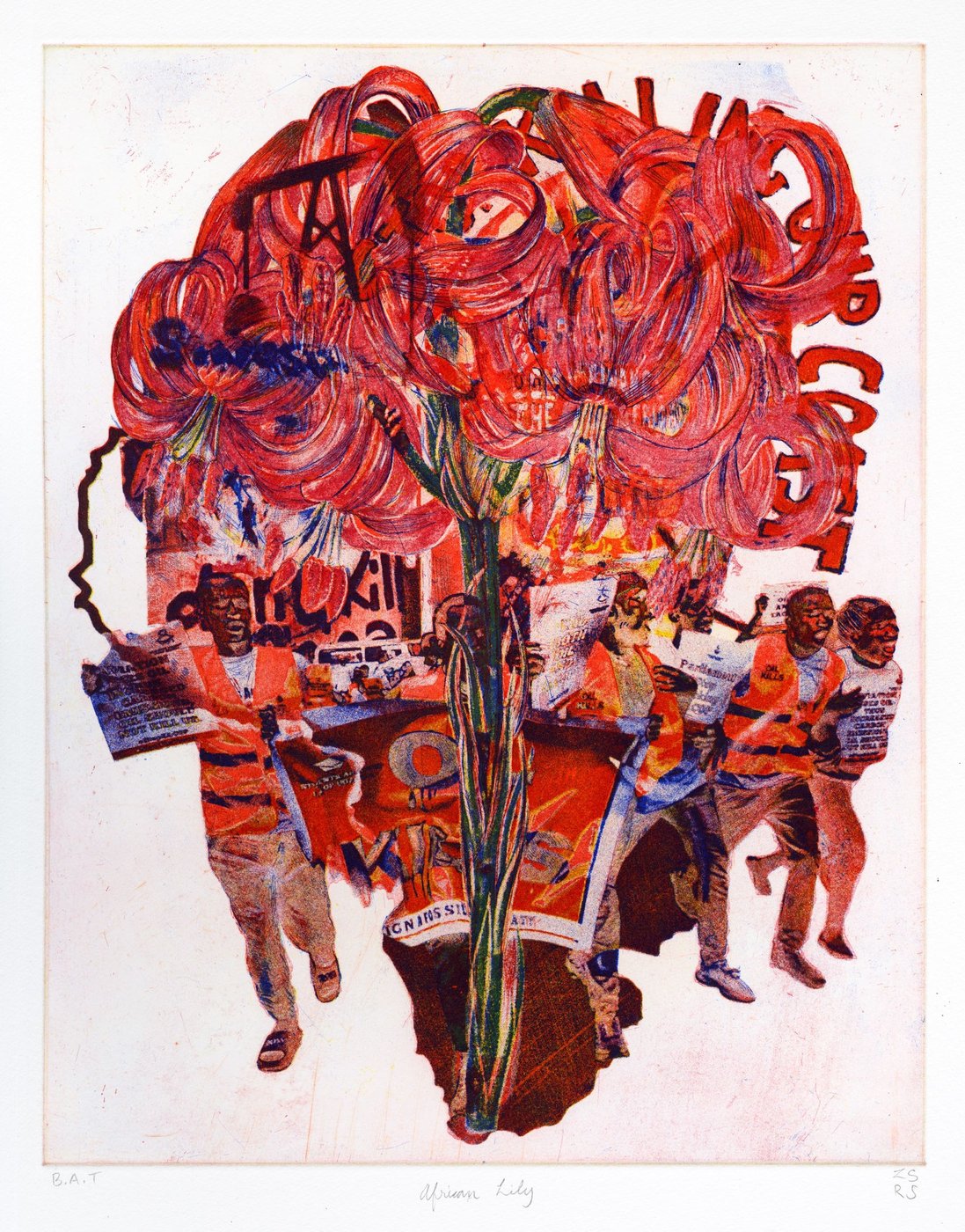
Spring Wake, a series of multi-plate color etchings, is another creative response to the climate crisis. The series borrows from a history of botanical illustration tied to colonial structures and emerging capitalism, reimagining flowers as a form of resistance aligned with local and global environmental movements. Created in collaboration with Columbia University’s Neiman Center for Print Studies, the series pairs native plants with images of environmental protests with indigenous flora overlaid atop a local environmental threat.
Woodcut is a slow, often DIY process. Sidhu and Swainston’s works ask for slow consideration, the antithesis to our current barrage of mass circulated news media. The active contemplation of images invites viewer participation in decoding them, encouraging the consideration of our past to create a better future.