Anca Benera and Arnold Estefán represent Romania at the 61st Venice Biennale
Anca Benera is a PhD student at the Academy of Fine Arts Vienna and received the Birgit Jürgenssen Prize in 2022. This year, she and her partner Arnold Estefán are representing Romania at the Venice Biennale with the exhibition Black Seas – Scores for the Sonic Eye.
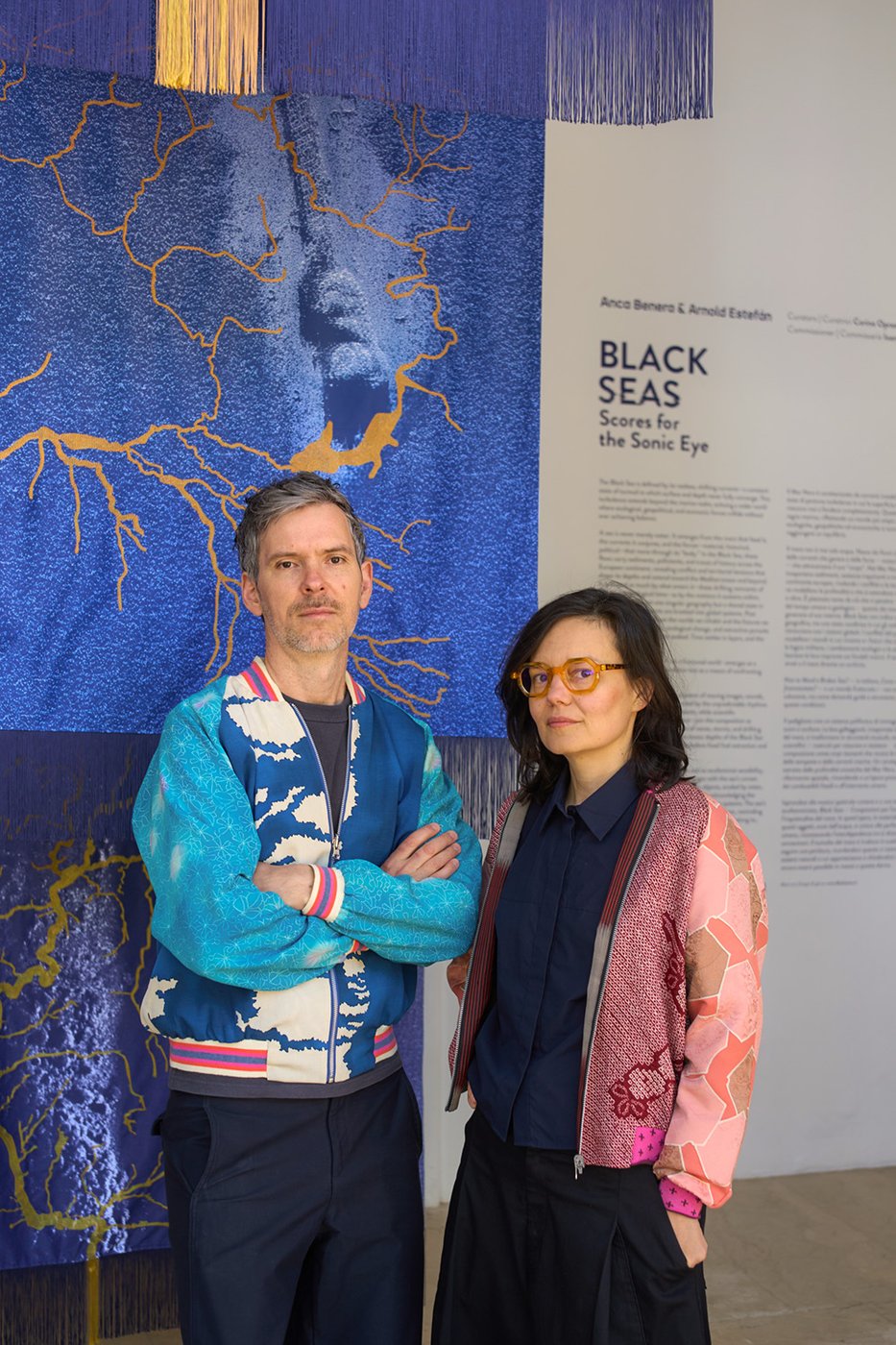
Developed for the Romanian Pavilion at the 61st International Art Exhibition - La Biennale di Venezia, Black Seas - Scores for the Sonic Eye unfolds as a multi-layered installation in which sound, moving image, sculpture, and scientific material form a shared field of inquiry. By activating acoustic and geological strands, the artists offer a reading of the Black Sea that is mediated through oceanographic processes, infrastructures of extraction, and overlapping histories of empires and trade routes connecting it with the Mediterranean and beyond.
The Black Sea as motif, metaphor, and system of relations
The Pavilion is grounded in sustained research on the Black Sea as an ecological basin and geopolitical frontier where histories remain literally submerged. The Black Sea is often described as a marginal, semi-enclosed sea defined by borders, yet it remains deeply connected to broader ecological, geopolitical, and economic systems. lt functions as a stratified body in which surface waters remain separate from anoxic depths below-among the largest of their kind in the world-where decomposition slows down, and the sea becomes an archive.
The artists present an installation in which video, sound and sculptural elements attune to the Sea, as the Danube, the Don, and the Dnieper flow into it - vast river systems that transport sediment and memory from across the continent, carrying Europe's intertwined colonial and political histories. These currents extend toward the Mediterranean and the Adriatic, situating the Sea within broader systems of circulation, migration, and exchange that historically connected it to Venice, as weil as to routes between Asia and Europe. In its anoxic depths, traces of empire, extraction, displacement and ecological change persist, pressing on the material and political present.
Anca Benera and Arnold Estefán have worked together as an artist duo since 2012 and are currently based in Vienna. Their practice spans multimedia installation, sculpture, and drawing, exploring the intersections of history, environment, and resource politics. Recent works investigate how military imaginaries shape landscapes, climates, and communities, examining the ways past conAicts continue to inAuence the environments we inhabit and the futures we imagine.
Their work has been exhibited in museums and biennials including Manifesta 15, Barcelona (2024); Kyiv Biennial (2025, 2023, 2015); Kunsthalle Mainz (2025); Matsudo International Science Art Festival, Tokyo (2025); Creative Time Summit, New York (2024); 1st Klima Biennale, Vienna (2024); Art Encounters, Timisoara, Romania (2024 - solo); Neuer Berliner Kunstverein, Berlin (2023 - solo); Whitechapel Gallery, London (2022); Museum Tinguely, Basel (2022); Migros Museum, Zürich (2021); Ludwig Museum, Budapest (2021); Talbot Rice Gallery, Edinburgh (2021); 39th EVA International - lreland's Biennial (2020).