Film Screening
As part of Let’s Stick with Unicorns, we present four films that bring together diverse perspectives on ecology, extraction, and the relationship between humans, environments, and power.
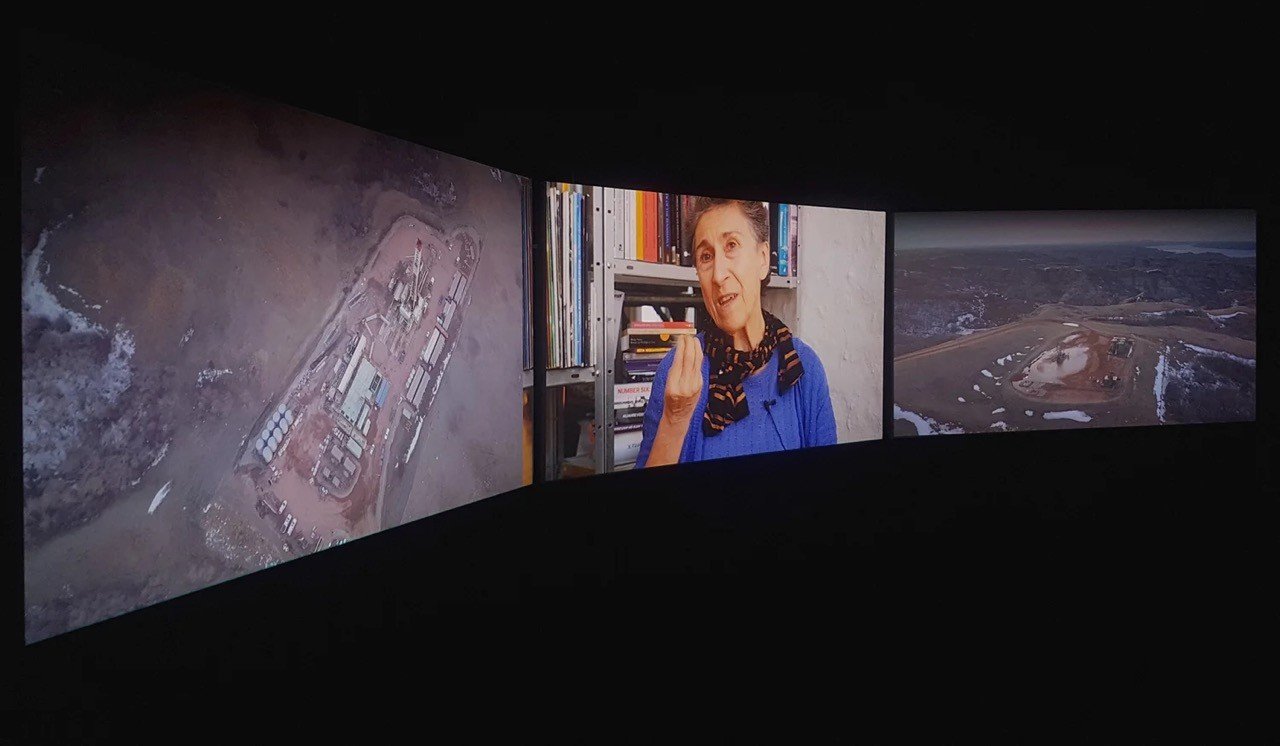
Moving between local stories and global entanglements, they reveal how questions of nature are always intertwined with social, political, and historical dimensions. Together, they open a space to question dominant notions of resources, urban life, and knowledge, while making alternative forms of coexistence visible.
Three (or more) Ecologies: A Feminist Articulation of Eco-Intersectionality
Angela Anderson
3 Channel Video Installation,HD,Stereo,37min, 2019
The way one relates to land, water and “resources” is reflected in the way one produces goods, relations and affinities. “Three (or more)Ecologies: A Feminist Articulation of Eco-intersectionality – Part I: For the World to Live, Patriarchy Must Die” juxtaposes the highly industrial/technical nature of the destructive fracking industry driving North Dakota’s Bakken shale oil boom on the Ft. Berthhold - Three Affiliated Tribes Reservation with voices from Jinwar – Village of Free Women, a women’s collective agricultural village project in the autonomous region of Rojava (Northern Syria).
The first chapter of this ongoing audio-visual research project emphasizes the urgent necessity of redefining value in the face of economic models that are driving the current climate crisis and the ongoing disruption/destruction of ecosystems, with blatant disregard for the embodied knowledge these ecosystems cultivate and nourish. It calls into question capitalism’s unbridled accumulation, fostered by competition, inequality and exploitation, the undergirding of patriarchal society, and comes to a singular conclusion: For the world to live, patriarchy must die.
Stone of Hell
Tekla Aslanishvili & Giorgi Gago Gagoshidze
24 min, 2021
AVCHD Digital film; Archival and found footage / 24:00’ / Germany, Georgia / 2021
Film by Tekla Aslanishvili and Giorgi Gago Gagoshidze
Producer Tamar Qeburia
Camera by Nikoloz Tabukashvili / Music by Nika Pasuri / Sound recordings by Irakli Shonia /
Voice actors - Sarah Kivi and Tornike Bziava
Color grading by Sally Shamas.
The starting point for the experimental documentary film is a small town in the republic of Georgia, Chiatura, whose economy has historically been heavily dependent on mining activities. Following the raw materials extracted on site through all stages of processing and distribution, we zoom out from the local context of the town to scrutinize the geopolitical and economic interrelations that link this peripheral site of extraction to a vast network of places, subjects and processes across the globe, exploring the new modes of war production engendering our present.
Supported by the Senate of Berlin - Department for Culture and Europe, Salzburger Kunstverein and Heinrich Böll Foundation.
Gardens in Between
wenfei zhao
7min
This video looks at small gardens and vegetable patches in the residential neighborhood where I grew up. These spaces are not officially planned or clearly defined, but are continuously made and remade through everyday use. People plant, sit, and gather there, sometimes following rules, sometimes ignoring them. I am interested in these in-between spaces that fall outside standardized planning. Are they informal occupations, or simply part of how the city is lived? The work stays with these ordinary forms.
Mururu, Irupé, Aguapé, Jaçanã, Uapê
Raphael Röösli
Digital Video colour with Stereo Sound, 3840x2160, Portuguese and English (with English Subtitles)
16:20 min
Mururu, Irupé, Aguapé, Jaçanã, Uapê, thematize identity on a sociocultural and personal level. The short film follows the famous water lily back to its roots in South America where a Myths takes place. It’s following History making by Colonialism and Western Science Epistemology the plant finds itself in a system which did not allow the plant and its connected culture to get roots.
But a botanical garden needs to be kept taking care of.